

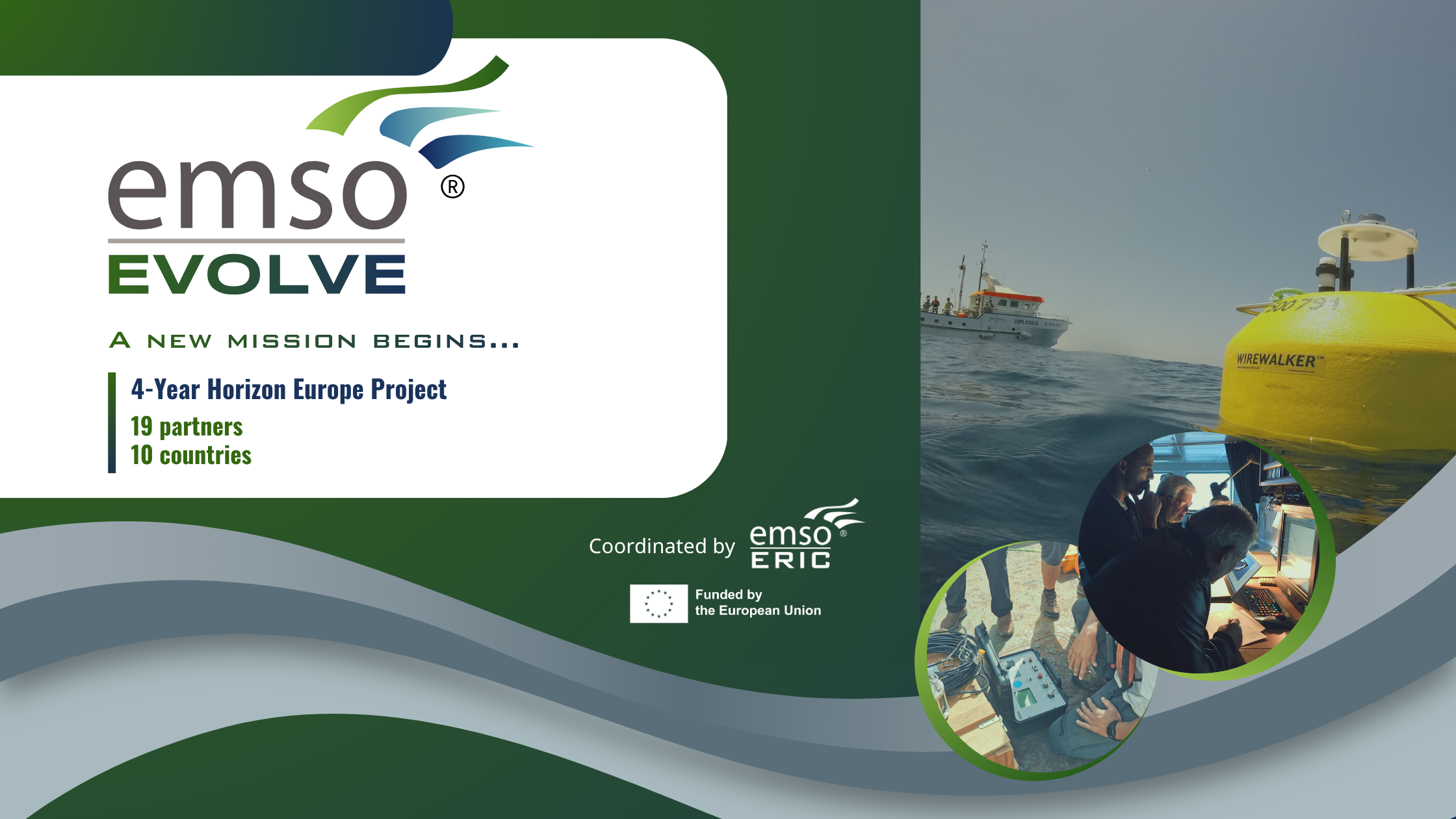
A new Horizon Europe project coordinated by EMSO ERIC brings together 19 partners from 10 countries to prepare Europe’s deep-ocean observatories for the decade ahead.
EMSO ERIC, the European Research Infrastructure Consortium that operates the European Multidisciplinary Seafloor and water column Observatory, announces the start of EMSO EVOLVE (European VisiOn for Long-term ocean observations and enVironmEntal sustainability): a four-year project funded by the European Union’s Horizon Europe programme to position EMSO as Europe’s leading long-term ocean observing infrastructure by 2035, moving from observation at individual sites towards sub-basin scale observation and service-oriented operations.
Why the deep ocean needs sustained observation
The ocean regulates our climate, absorbs a large share of the heat and carbon dioxide produced by human activity, hosts most of the planet’s living space, and generates hazards, from earthquakes and tsunamis to underwater landslides, that put humans and their infrastructures at risk. Yet the deep sea and water column remain among the least observed environments on Earth.
Understanding how the ocean is changing requires measurements taken continuously, in the same places, over decades. Satellites see the surface; only in-situ observatories can track what happens from the seafloor to the surface, year after year. EMSO EVOLVE is built around four challenges where those long-time series matter most: climate and ocean variability, geohazards, biodiversity loss, and the deep-ocean carbon cycle, warming and acidification.
Building on what EMSO already does
EMSO EVOLVE does not start from zero. EMSO ERIC has operated the observatory infrastructure since 2016 through a distributed system spanning 14 Regional Facilities across 21 sites, from the Nordic Seas to the Black Sea and out into the Atlantic, run by more than two dozen institutions, delivering around 125 in-situ variables from the seabed to the sea surface. That includes cabled observatories, seafloor stations, mooring lines, profilers and surface buoys, as well as shallow-water test sites used for engineering and training. These facilities are open to the research community: scientists across Europe and beyond can access EMSO data freely online, and apply for physical access to the observatories themselves through the Transnational Access programme.
What EMSO EVOLVE adds is the next stage of maturity: stronger governance, a sustainable funding base, a revised observing design that better integrates observing systems at oceanic regional and sub-basin scales, modern data services, and the people and skills to run it all.
What the project will do
The work is organised around four primary objectives:
Strengthen governance and grow the membership. The project will formalise EMSO’s national nodes, harmonise their structure, strengthen EMSO’s position in national research infrastructure roadmaps, and support new countries on the path to membership, alongside a revised business and funding plan that ties EMSO’s value to the Blue Economy.
Redesign observation for regional scale. Working with national systems and sister marine research infrastructures, EMSO EVOLVE will update the observing design to address region-scale variability across the four challenges, deepening cooperation with the modelling and satellite communities.
Modernise data and digital services. The project will upgrade EMSO’s e-infrastructure end-to-end: a common Observatories of Seas Ontology, stronger quality control and metadata, a modern data portal with virtual access, and AI- and HPC-ready workflows that are FAIR and interoperable with EMODnet, Copernicus and Digital Twin of the Ocean initiatives such as EDITO and DestinE. It will also make EMSO capacities easier to access: expanded Virtual Access services, and a new online platform where researchers can browse EMSO’s facilities, check availability, and apply for physical access through a single point of entry.
Build capacity through the EMSO Academy. EMSO EVOLVE will institutionalise the EMSO Academy as a lasting training arm, mapping skills across the network and delivering courses, webinars, summer schools and staff mobility for the teams that operate the infrastructure, and for the wider community that uses it.
The project at a glance
| Full name | European VisiOn for Long-term ocean observations and enVironmEntal sustainability |
| Partners | 19 organisations from 10 countries |
| Coordinator | EMSO ERIC (Rome, Italy) |
| Duration | 48 months, 1 September 2026 to 31 August 2030 |
| Total budget | €4.99 million, with an EU contribution of €3.99 million |
| Programme | Horizon Europe, call HORIZON-INFRA-2025-01 (Research Infrastructures), Grant Agreement No 101292761 |
Follow the project
Over the next four years, we will share the project’s progress, data stories from the Regional Facilities, training opportunities through the EMSO Academy, and ways for the ocean observing community to get involved. To stay in touch: subscribe to the EMSO newsletter, follow EMSO on LinkedIn and Facebook, and explore the EMSO EVOLVE project page.
The EMSO EVOLVE consortium
EMSO EVOLVE brings together the following organisations:
Coordinator: EMSO ERIC – European Multidisciplinary Seafloor and water column Observatory, European Research Infrastructure Consortium (HQ: Rome, Italy)
Italy: Istituto Nazionale di Oceanografia e di Geofisica Sperimentale (OGS); Istituto Nazionale di Geofisica e Vulcanologia (INGV); Consiglio Nazionale delle Ricerche (CNR)
France: Ifremer; Centre National de la Recherche Scientifique (CNRS), with Aix-Marseille University as affiliated entity; IEEE France Section
Portugal: Centro de Ciências do Mar do Algarve (CCMAR); Instituto Português do Mar e da Atmosfera (IPMA)
Greece: Hellenic Centre for Marine Research (HCMR); Athens University of Economics and Business – Research Center (AUEB-RC)
Spain: Universitat Politècnica de Catalunya (UPC); Plataforma Oceánica de Canarias (PLOCAN)
Romania: National Institute of Marine Geology and Geoecology (GeoEcoMar)
Ireland: Marine Institute (MI)
Ukraine: Institute of Market and Economic & Ecological Researches of the National Academy of Sciences of Ukraine (IMEER NASU)
United Kingdom: Blue Lobster IT Limited
Norway: Institute of Marine Research (IMR)
Funded by the European Union under grant agreement No 101292761. Views and opinions expressed are those of the author(s) only and do not necessarily reflect those of the European Union or the European Research Executive Agency (REA). Neither the European Union nor the granting authority can be held responsible for them.