

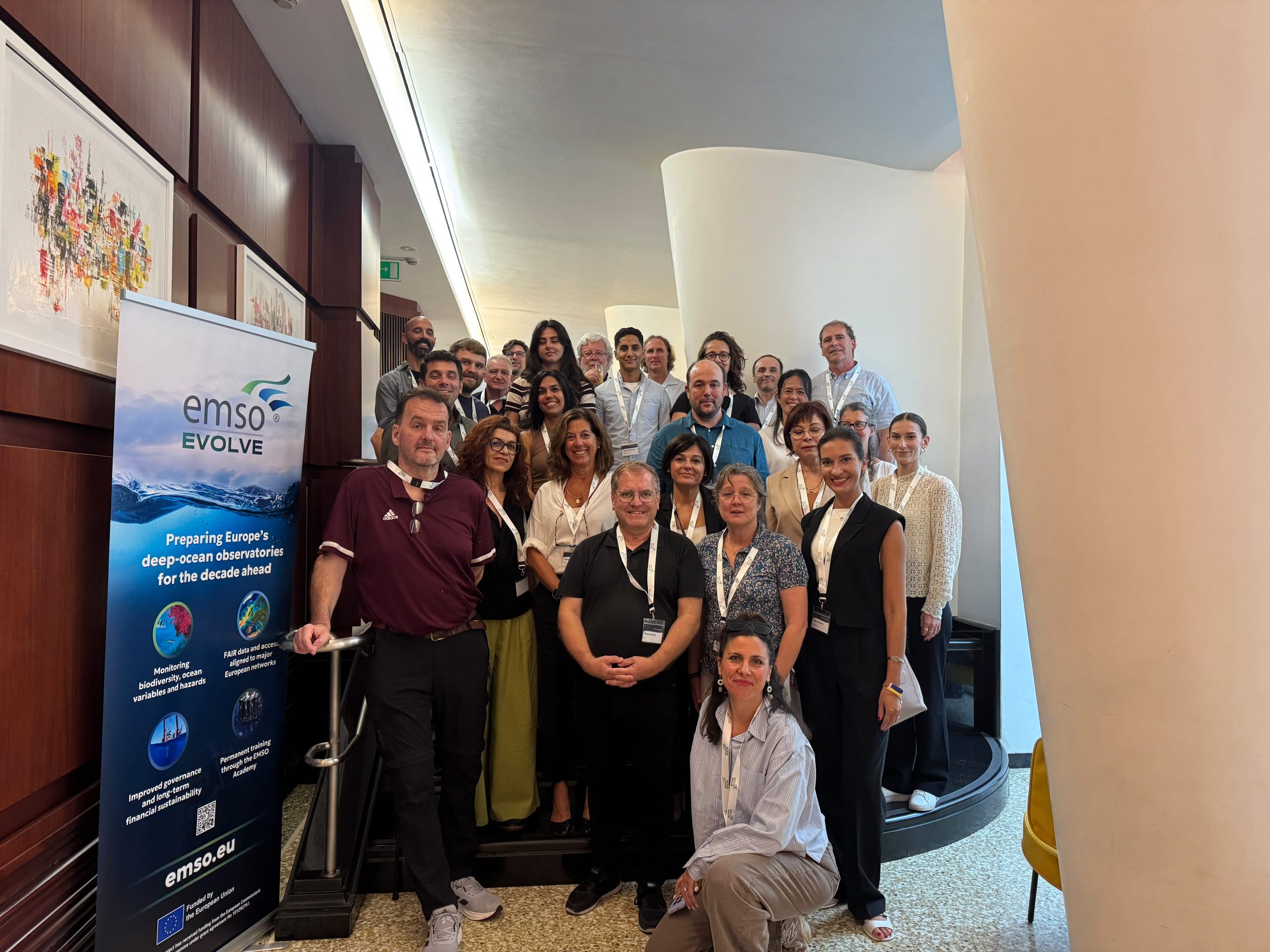
EMSO EVOLVE has moved from announcement to action. This week, representatives of all 19 partner organisations from 10 countries are in Rome for the
project’s kick-off meeting: three days, from 6 to 8 October, to turn a four-year plan for Europe’s deep-ocean observing infrastructure into a working programme.
EMSO EVOLVE launched on 1 September: a Horizon Europe project, coordinated by EMSO ERIC, to position EMSO as Europe’s leading long-term ocean observing infrastructure by 2035. The mission centres on four challenges where long time series matter most: climate and ocean variability, geohazards, biodiversity loss, and the deep-ocean carbon cycle, warming and acidification. The kick-off turns that mission into assignments, deadlines, and a calendar.
Three days in Rome
Day one belongs to the people. After a welcome from EMSO ERIC’s Director General and the project’s vision, the European Commission sets out its expectations, and each partner takes the floor for five minutes to say what they bring and what they expect.
Day two is the working core. The morning covers how the project runs: the grant and consortium agreements, reporting, and the governance bodies to be appointed. Then the work packages take over, with sessions on integrating EMSO with national systems and regional facilities for basin-scale observation; developing the e-infrastructure behind EMSO’s data services; governance and operational structure; and long-term financial sustainability. Each session ends with an action plan for the first eighteen months.
Day three looks at the people and the public: the EMSO Academy, the capacity-building programme the project will make a lasting part of EMSO, and the communication work that will carry the project’s results outwards. The meeting closes by agreeing the first-year action plan, the measure against which the consortium will check itself twelve months from now.
Why it matters
The deep sea and water column remain among the least observed environments on Earth, yet the ocean regulates our climate, absorbs a large share of the heat and carbon dioxide produced by human activity, and generates hazards from earthquakes to underwater landslides. Satellites see the surface; only in-situ observatories can track what happens from the seafloor to the surface, year after year. EMSO has been doing exactly that since 2016, through 14 Regional Facilities across 21 sites delivering around 125 in-situ variables. EMSO EVOLVE is how that infrastructure gets ready for its next decade.
Follow the project
Over the coming four years, we will share progress, data stories from the Regional Facilities, and training opportunities through the EMSO Academy. To stay in touch, follow EMSO on LinkedIn, Facebook and signup to the EMSO newsletter, or explore emso.eu.
Funded by the European Union under grant agreement No 101292761. Views and opinions expressed are those of the author(s) only and do not necessarily reflect those of the European Union or the European Research Executive Agency (REA). Neither the European Union nor the granting authority can be held responsible for them.