
194 days at sea: how FOOD used EMSO Physical Access to validate a wooden ocean drifter
24 November 2026
A lower-plastic prototype moved from controlled testing to real-ocean validation at OBSEA, showing that a wooden hull could support reliable environmental observations under demanding marine conditions.
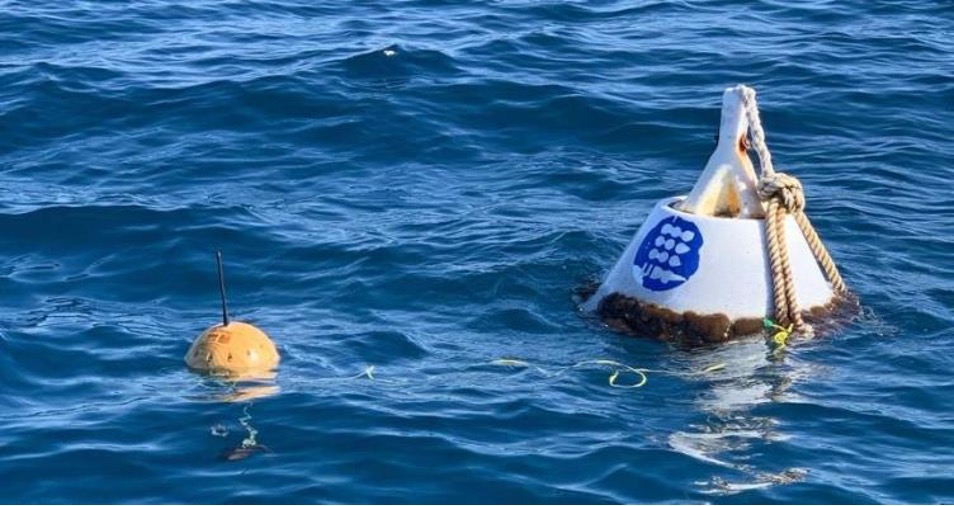
Picture: Wooden FOOD drifter prototype moored at the EMSO OBSEA Regional Facility off the coast of Vilanova i la Geltrú, Spain, during real-sea validation. Source: FOOD Final Project Report.
The challenge
Drifting buoys are a core part of operational ocean and weather observation. The standard Surface Velocity Profiler barometer drifter (SVP-B) used across the global observing network is, however, plastic-heavy: its roughly 40 cm hull is made from acrylonitrile butadiene styrene (ABS), and most units are not recovered after their service life. The FOOD (Future Ocean Observation Drifter) project addressed this sustainability issue while also testing an alternative to dependence on a single satellite transmission provider. CLS (Collecte Localisation Satellites) and its partner E-Surfmar needed to know whether a wooden buoy carrying environmental and positioning sensors could survive the open sea, transmit data reliably and be practical to recover, repair and reuse.
The solution
Building on a prototype developed through earlier work, CLS produced a wooden sea-surface drifter equipped with a sea-surface temperature sensor, GPS (Global Positioning System) and an Argos/Kineis satellite communication modem, enabling the prototype to transmit environmental and technical data from sea such as battery use. FOOD tested the complete platform in the open sea and determined whether the wooden hull, sensor package and communications strategy could withstand realistic conditions over an extended period.
Why EMSO Physical Access?
CLS used EMSO Physical Access to move the FOOD prototype into a demanding real-ocean trial. The buoy was deployed at the OBSEA (Expandable Seafloor Observatory) Regional facility, operated by UPC (Universitat Politècnica de Catalunya) off Villanova, Spain. The site was selected for its proximity, available equipment and exposed conditions, as well as access to meteorological observations that allowed CLS to understand the environment experienced by the prototype. The local UPC team also provided essential operational support: after the first mooring line failed and the buoy washed ashore, they recovered the platform, enabling inspection, repair, battery replacement and a second deployment.
Two deployments, one validation path
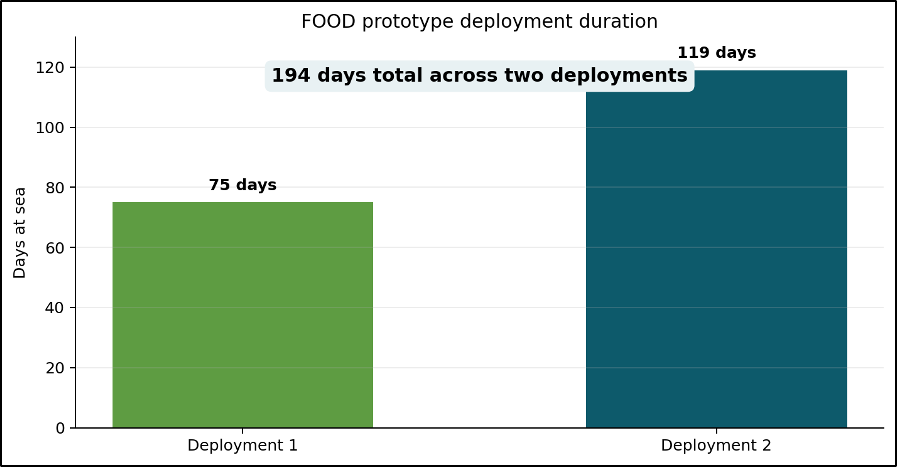
Graph-1: FOOD completed two open-sea trials: 75 days during the first deployment and 119 days during the second, giving the wooden prototype a cumulative 194 days at sea. Data: FOOD Final Project Report.
From deployment to results
The first deployment began on 10 April 2024. After 75 days, the buoy broke free from its mooring and washed ashore near Villanova while continuing to transmit. Recovery on 26 June made it possible to inspect the hull and electronics. The damage was limited to a small crack and minor seawater ingress; the electronics and batteries remained functional. The crack was repaired locally with commercially available nautical sealant and the batteries were replaced, demonstrating that the platform could be reconditioned without returning it to the manufacturer.
The second deployment began on 26 October 2024 and lasted 119 days. The mooring line again failed, after which the buoy drifted eastward for 84 days, including through busy shipping lanes, while continuing regular transmissions. It stopped transmitting on 20 February 2025 between Majorca and Sardinia. Because the buoy was not recovered after the second deployment, the exact cause of the final loss of transmission could not be determined. Possible explanations identified in the final report include collision damage, antenna failure, water ingress or recovery by another vessel.
KEY RESULT 194 days at sea across two deployments The wooden prototype validated GPS, sea-surface temperature and Argos/Kineis communications, while the second deployment exposed it to winter conditions with significant wave heights often exceeding 6 m. |
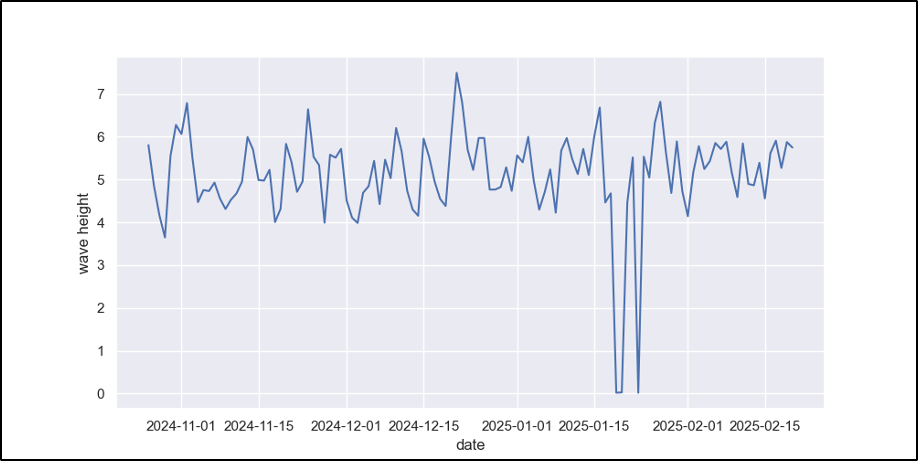
Graph-2: Significant wave height recorded along the buoy's trajectory during the second deployment. Winter conditions frequently exceeded 6 m, providing a demanding real-sea test of the wooden hull. Source: FOOD Final Project Report.
What FOOD demonstrated
The trials confirmed good performance from the GPS, temperature sensor and Kineis modem and antenna. The first recovery also provided an important durability test: despite repeated impacts while beaching on a rocky coastline, the buoy sustained only minor damage and remained repairable. The ease of opening the platform, changing batteries and sealing the hull locally supports the project goal of a reusable and maintainable observing platform.
The second deployment added evidence of robustness under winter sea states and during an extended free drift. In total, the Woodhull design accumulated 194 days at sea. FOOD successfully demonstrated the use of wood as an alternative to plastic for drifting-buoy hulls. At the same time, both deployments highlighted a practical operational issue: the mooring line was probably cut by vessel propellers, suggesting that future trials may benefit from a protective cage or another recovery-oriented deployment arrangement.
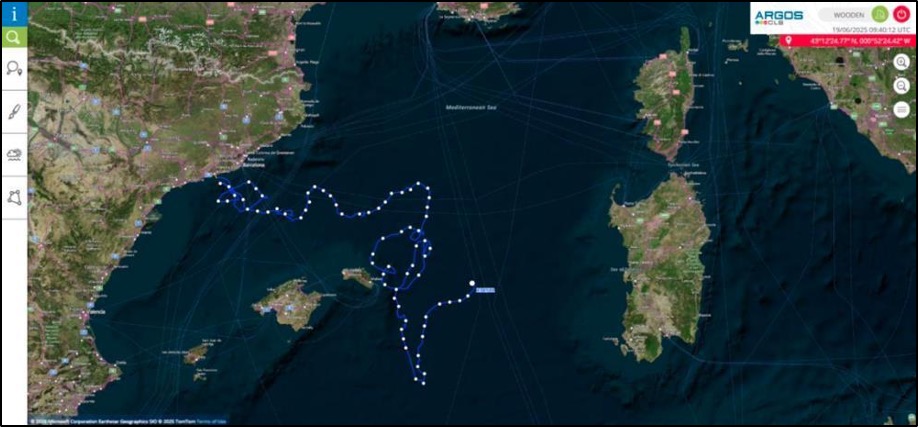
Graph-3: GPS trajectory of the FOOD prototype after it broke free from its mooring during the second deployment. The buoy drifted eastward for 84 days while continuing to transmit data before communications stopped between Mallorca and Sardinia. Source: FOOD Final Project Report.
Impact and next steps
FOOD moved the wooden drifter concept beyond laboratory and sheltered testing into open-sea validation. The next development step identified by CLS is to transform the prototype into an industrial design suitable for standardized manufacturing. This includes redesigning the electronics to simplify assembly and reduce cost. CLS & E-Surfmar are also considering the addition of a barometer, which would make the platform more useful to National Weather Providers that require sea-level pressure observations, while introducing a new engineering challenge: exposing the pressure sensor to air without allowing water to reach the electronics.
“For innovation projects, It would be difficult for our company to access the ocean in order to test new equipment without facilities such as EMSO ERIC. This facility with its support team and equipment enables us to test prototypes and refine the design.” Marc Lucas and Philippe De Saint Léger |
The FOOD project illustrates how Physical Access can help marine-technology developers move from prototype development to evidence from real operational conditions. By combining access to OBSEA with local technical and logistical support, the activity enabled CLS to test the full platform, learn from failure modes, recover and redeploy the prototype, and define the next engineering steps toward a standardized product.
View FOOD Project Report: Link
CLS (Collecte Localisation Satellites) Website: Link
Institution's involved:
Project: FOOD
User: CLS (Collecte Localisation Satellites)
Regional Facility: OBSEA (Expandable Seafloor Observatory)
Facility Operators: UPC (Universitat Politècnica de Catalunya)