
Tracking microplastics below the surface: how CUPIDO used EMSO Physical Access to investigate plastic and carbon export
24 November 2026
CUPIDO used EMSO Physical Access at the South Adriatic Sea regional facility to track how microplastics move, weather and interact with ocean carbon export under real marine conditions.
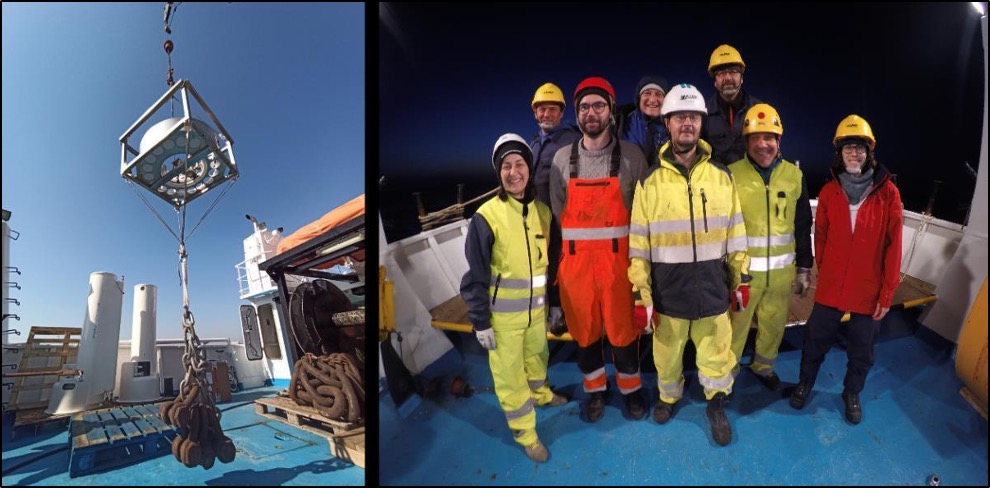
Picture credit: Left: OPIC, Ocean Plastic In-situ Incubator Chambers, first deployment in the Mediterranean Sea. Right: Cruise team on the DALLAPORTA research vessel including some members of the CUPIDO team. Source: CUPIDO Final Project Report / EMSO ERIC.
The challenge
Plastic pollution is increasingly present throughout marine ecosystems, yet understanding what happens to microplastics once they leave the ocean surface remains difficult. Microplastics interact with zooplankton and other components of marine food webs. Zooplankton can ingest plastic particles and repackage them into faecal pellets, while plastics can also become incorporated into their tissues. Both processes may contribute to moving plastics deeper into the water column. At the same time, these biological processes are closely connected with the natural transport of carbon from surface waters toward the deep ocean. CUPIDO (CalcUlating the strength of the Plastic pump In counteracting the Deep export of Oceanic carbon) set out to investigate this connection in contrasting marine environments: the Southern Ocean and the Mediterranean Sea.

Picture credit: Zooplankton and the biological carbon pump: illustration showing how zooplankton contribute to transporting carbon from surface waters toward the deep ocean, the process investigated by CUPIDO in relation to microplastic pollution. Source: CUPIDO presentation.
The solution
CUPIDO combined marine biogeochemistry with research into plastic pollution, examining how plastics change while exposed to the natural marine environment and how they move vertically through the water column. At the South Adriatic site, the team deployed Ocean Plastic In-situ Incubator Chambers, a device developed specifically to expose selected meso and microplastics to natural ocean conditions over periods ranging from months to a year. A specially designed Floating Trap simultaneously measured plastic and carbon transport through the upper 200 m of the water column.
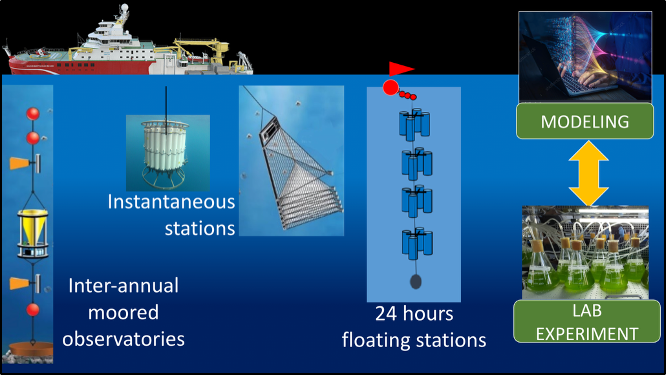
Picture credit: CUPIDO experimental approach: combining long-term moored observations, short-term floating stations, laboratory experiments and modelling to investigate interactions between microplastics and ocean carbon export. Source: CUPIDO presentation.
Why EMSO Physical Access?
EMSO Physical Access gave CUPIDO access to the South Adriatic facility operated by OGS and CNR-ISP for a long-term deployment. OPIC was installed in spring 2022 and recovered in autumn 2023, allowing the team to observe plastic weathering directly under real ocean conditions. The Deployment and recovery took place during research cruises aboard the G. Dalla Porta and Gaia Blu.
From deployment to results
The first results show that microplastic pollution extended well below the surface layer.
KEY RESULT 814 microplastic pieces m⁻² day⁻¹ at 100 m depth 87% of the recorded plastic flux consisted of particles smaller than 1 mm. |
CUPIDO measured microplastic flux reached a maximum of 814 pieces m⁻² day⁻¹ at 100 m, while particles smaller than 1 mm represented 87% of the measured flux. The results show that significant microplastic transport occurs well below the surface and contributed up 13% to carbon flux providing new evidence for investigating its relationship with carbon cycling. The long-term OPIC experiment also showed that all selected plastic fragments changed during exposure, including changes in density and porosity that can influence their sinking potential.
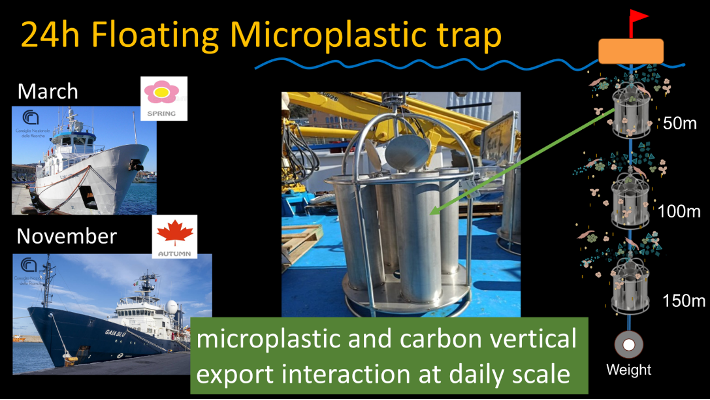
Picture credit: Floating microplastic trap experiment: trap units were deployed at different depths to measure daily-scale microplastic and carbon export through the water column. CUPIDO used sampling depths including 50 m, 100 m and 150 m. Source: CUPIDO presentation.
Impact and next steps
The project is building evidence on what happens to microplastics beneath the ocean surface before they eventually reach deeper waters or the seabed. Understanding these pathways can support the development of biogeochemical models that incorporate interactions between microplastic transport and carbon export.
Three peer-reviewed papers are planned, and the data collected through CUPIDO are expected to support modelling of interactions between microplastics and ocean carbon export. The team also identifies renewed access to the EMSO ERIC programme as a next step, with the ambition of integrating CUPIDO tools and data into long-term observatories and expanding monitoring of plastics and their relationship with the carbon cycle.
“CUPIDO brings together UK, European, and international expertise, creating synergies with polar regions and EMSO marine sites in the Mediterranean. CUPIDO enriches EMSO ERIC by expanding its scientific scope into the emerging field of plastic carbon interactions, providing novel tools, data, and policy insights that make observatories even more relevant to society and decision-makers.” Clara Manno, British Antarctic Survey |
EMSO ERIC Physical Access gives researchers, engineers and innovators opportunities to test instruments, technologies and scientific approaches in real ocean conditions across EMSO Regional Facilities, supported by marine infrastructure and scientific, technical and logistical expertise.
View CUPIDO Project Report: Link
Youtube short video about the project: Link
Discover more about the Physical Access: Link
Institution's involved:
Project: CUPIDO
User: British Antarctic Survey: Natural Environment Research Council
Facility Operators: ISP-CNR (Institute of Polar Sciences – National Research Council), OGS (National Institute of Oceanography and Applied Geophysics)