

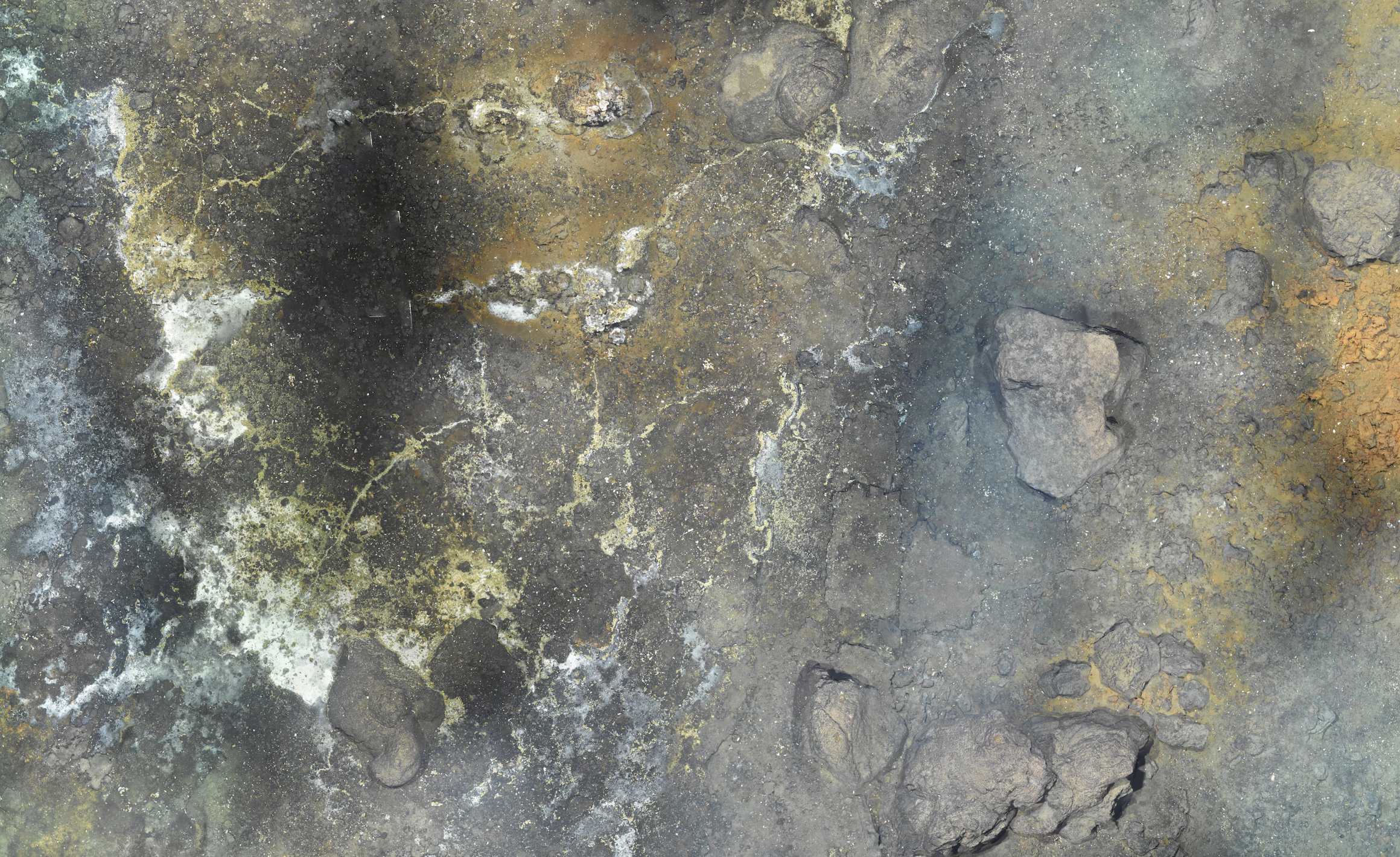
The EMSO-Azores observatory has been monitoring since 2010 the Lucky Strike hydrothermal vent field, located at 1700 m depth along the Mid-Atlantic Ridge in the Azores Marine Protected Area. Hydrothermal vents result from the circulation of seawater through the oceanic crust which re-emerge at the seafloor as hot, mineral-rich fluids. When they mix with the cold seawater, these fluids precipitate minerals that build hydrothermal edifices rich in metals of commercial interest. As a result of subsurface fluid circulation, vent fields create a patchwork of seafloor habitats, shaped by complex terrain and venting activity.
Repeated annual visits at the Lucky Strike vent field for the maintenance of the observatory allow to capture detailed imagery of thousands of kilometre square of seabed. Pictures acquired with the ROV Victor6000 along transects at 3 m above the seafloor are merged into large scale orthomosaics that are then analysed using mapping tools to study how environmental conditions shape deep-sea vent and non-vent benthic communities. This study revealed a mosaic of life: environmental heterogeneity occurs over small scales of few meters even beyond venting areas. Vent structures support hotspots of specialized species like Bathymodiolus azoricus, while nearby slabs host dense populations of mobile bathyal shrimp. Areas farther from vents show higher species diversity, especially on hard, complex basalt surfaces where sessile organisms such as octocorals and sponges thrive.
While hydrothermal intensity drives broad zonation, seabed topography and substratum type strongly influence local abundance and diversity, creating intricate patterns at surprisingly small scales. These findings highlight the rich complexity of vent ecosystems with the occurrence of distinct benthic communities beyond venting zones, emphasising the ecological significance and vulnerability of areas that could be targeted by mining. The analyses of transects conducted in the same areas over the years will allow the integration of temporal dynamics to better assess vent ecosystem resilience including the full range of habitat diversity, which would all be at risk in the case of potential deep-sea mining.
Photo: Reconstructed mosaic of the Roldan vent site from high resolution picture collected using the ROV Victor6000. Credit: Ifremer/Momarsat 2023
Publication reference: Loïc, V.A., Jozée, S., Annah, R. et al. The role of habitat mosaics on biological communities at hydrothermal vents and their periphery. Sci Rep (2026). https://doi.org/10.1038/s41598-026-39544-x
AUTHORS
Van Audenhaege Loïc1,2*, Sarrazin Jozée2, Ramière Annah2, Borremans Catherine2, Marcillat Marin2, Soto Vega Pedro Juan2, Cannat Mathilde3, Marticorena Julien4, Colaço Ana5, Matabos Marjolaine2
Affiliation/Institution:
1 National Oceanography Centre, Southampton, United Kingdom
2 Univ Brest, Ifremer, BEEP, F-29280 Plouzané, France
3 Université Paris Cité, Institut de Physique du Globe de Paris, UMR 7154 CNRS, Paris, France
4 ABYSSA, French Company for the Deep-Ocean Exploration, Anglet, France
5 University of the Azores, Institute of Marine Sciences – OKEANOS Horta, Portugal
*Corresponding author: loic.vanaudenhaege@gmail.com/loicva@noc.ac.uk