


A new gamma-ray spectrometer was deployed at the OBSEA Underwater Observatory on 4 September 2026 as part of the EMSO ERIC Physical Access Programme, marking the beginning of a six-month campaign to evaluate its performance under real marine conditions. The OBSEA Underwater Observatory, operated by the SARTI research group of the Universitat Politècnica de Catalunya (UPC), Spain, is hosting the LoRa (Long-term Underwater Radioactivity Sensor Validation) project, selected under the 2026 EMSO ERIC Physical Access Call.
Led by PLOATECH, with the participation of researchers from the National Technical University of Athens (NTUA) and the Woods Hole Oceanographic Institution (WHOI), the project aims to validate an innovative underwater gamma-ray spectrometer known as gSPEC, developed to measure radionuclides directly in the marine environment.
Advancing underwater radioactivity monitoring
Despite their importance for environmental monitoring, geophysical processes and nuclear safety, radionuclides remain relatively understudied in marine environments. Conventional monitoring approaches often require collecting water samples for subsequent laboratory analysis, limiting the availability of continuous measurements. The gSPEC sensor, originally developed through a Horizon 2020 FET Proactive project, uses compact gamma-ray detection technology to enable in-situ measurements of underwater radioactivity. Following previous short-term tests in marine environments, the LoRa project represents an important step towards demonstrating the instrument’s reliability during extended underwater operation.
“Radionuclides remain significantly under-measured in the marine environment, despite their relevance to environmental monitoring, nuclear waste management, tectonic activity, and large-scale accidental releases” , says Dr. Angelos Mallios, Principal Investigator of the project and Co-founder and Technical Director of PLOATECH. “For PLOATECH, this is an important step in taking our underwater sensing technology from development toward validated, long-term operation in the ocean”.
Six months of validation at OBSEA
The instrument was deployed on 4 September 2026 at the OBSEA observatory, located approximately 4 km off the coast of Vilanova i la Geltrú (Barcelona), at a depth of 20 metres. Over the planned six-month monitoring campaign, the research team will evaluate the sensor’s operational stability, measurement performance and long-term reliability, as well as its integration with a permanent ocean observing infrastructure. OBSEA’s cabled infrastructure provides continuous electrical power, real-time communications and remote access to deployed instruments. In addition, measurements from existing oceanographic sensors, including temperature, salinity and turbidity, provide valuable environmental context for interpreting the collected data. The results are expected to contribute to the development of new capabilities for continuous marine radioactivity monitoring, with potential applications in environmental assessment, geohazard research and offshore industrial activities.
OBSEA supporting innovation through EMSO ERIC
As an EMSO ERIC Regional Facility, OBSEA provides access to its infrastructure and technical expertise for external research groups and technology developers. The LoRa deployment demonstrates the importance of permanent marine observatories not only for collecting long-term environmental data but also as real-world testing platforms for emerging ocean technologies. Through the EMSO ERIC Physical Access Programme, OBSEA continues to strengthen collaboration between research institutions and industry, supporting the validation of innovative sensors and their transition towards operational marine applications.
Further information:
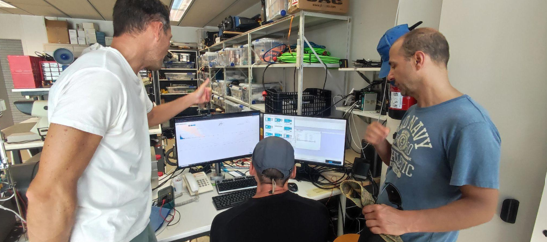
OBSEA and PLOATECH team during the deployment preparation
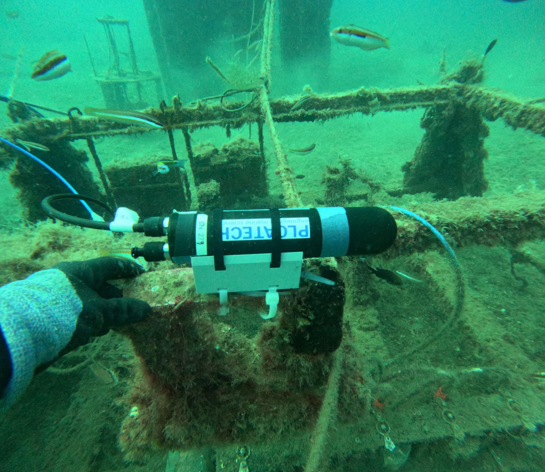
LoRa deployment at the EMSO OBSEA regional facility