

Hydrothermal vents along mid-ocean ridges constitute areas of important geochemical and thermal exchanges between the lithosphere and the global ocean. They host dense biomass of specialized and endemic fauna that rely on chemosynthetic energy provided by autolithotrophic organisms fuelled by chemical compounds contained in the hydrothermal fluid. Faced with the increasing exploitation of ocean resources in a changing ocean, there is now a growing recognition of the urgent need for a comprehensive assessment of the health and status of deep-sea ecosystems. However technological challenges, limited access and the high costs associated with deep-sea studies, have led to large knowledge gaps in our understanding of temporal change in these environments. Understanding their natural dynamics is key to assessing and predicting the impacts and their responses to large-scale disturbances caused by natural processes and human activities, including climate change.
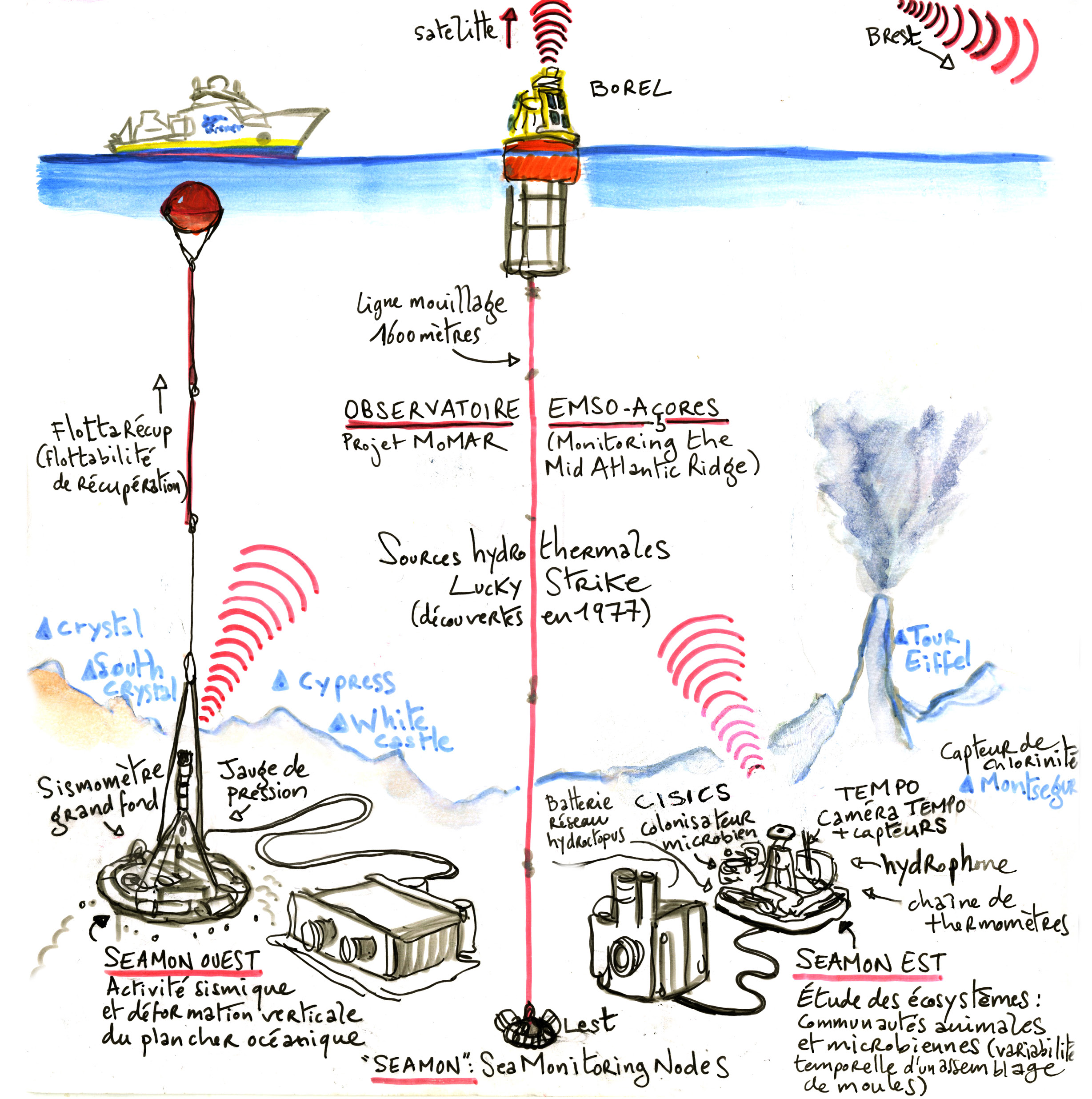
In this context, the battery-powered cabled EMSO-Azores was deployed in 2010 at 1700 m depth at the Lucky Strike vent field. The instrumental set-up aims at understanding the feedbacks between volcanism, deformation, seismicity, and hydrothermalism at a slow spreading mid-ocean ridge, and the coupling between the hydrothermal ecosystem and these sub-seabed processes. The first 15 years of data supported unprecedented integrated studies, highlighting the link between deep geological events, sub-surface hydrothermal circulation and its control on fluid chemistry as well as the links with biological communities with tidal modulation being the main process driving vent effluents variability, species behaviour and physiology. A summary of all results obtained since the beginning of the observatory was recently published in Matabos et al. 2025. This paper reports on the inter- and pluri-disciplinary scientific advances and technological developments enabled by the observatory the last 15 years and highlights how increased knowledge and the infrastructure contribute to enhance ocean literacy through a high number of outreach and art and science projects but also to inform environmental management and conservation in a Marine Protected Area (Portugal).
With 15 years of continuous observations at deep-sea hydrothermal vents along a slow-spreading mid-ocean ridge, EMSO-Azores holds the record of multidisciplinary ecosystem monitoring at hydrothermal vents and stands as a truly unique research infrastructure worldwide. Scientific advances pointed to a system driven by the tides but surprisingly stable over decades. Although located 1,700 metres below the surface, the system’s dynamics are governed by the semi-diurnal tidal cycle—from currents and fluctuations in hydrothermal flow to the behaviour and physiology of vent species. Tides also influence plume dynamics and facilitate particle export to the ocean. Surprisingly, results point to a relative stability of the system over decades with few stochastic geological events that punctually affected biological communities. The observatory supported the investigation of the longest high-resolution imagery time series of a vent faunal assemblage challenging the paradigm that hydrothermal vents are highly dynamic and ephemeral habitats.
15 years of expertise serving observational science
Over the past 15 years, the EMSO-Azores observatory has not only advanced scientific research but also served as a training ground for the next generation of deep-sea experts. More than 60 engineers, technicians, and scientists—half of whom are early-career researchers—have collaborated to maintain the observatory and conduct ground-breaking studies. This unique blend of human expertise and cutting-edge technology has set a new standard for deep-sea observational science. Beyond its scientific achievements, the observatory’s legacy lies in its wealth of data and hands-on experience. These resources are now shaping the design and development of the next generation of ocean observatories worldwide, ensuring that future research builds on the lessons learned from EMSO-Azores.
Deep-sea observatories like EMSO-Azores do more than gather data—they bridge the gap between science and society. Through creative and accessible platforms—blogs, social media, conferences, citizen science, exhibitions, radio, theatre plays, and even comics—the observatory’s discoveries and expeditions bring invisible yet vital ecosystems to life. By making these remote worlds tangible, EMSO-Azores fosters a deeper public connection to the ocean’s health and the urgent need to protect it.
Observation represents 31% of the actions endorsed by the UN Ocean Decade (with EMSO among them), and one of its ten major challenges is to ‘Expand the Global Ocean Observing System’. This underscores the crucial role of sustained observations in addressing societal challenges, including the impacts of climate change, industrial activities, and resource management. In this context, results from existing long-term time series, such as those supported by EMSO-ERIC, can help develop indicators of ecosystem change and contribute to international efforts to improve the global integration and interoperability of observing systems through international networks.
Figure 1. An artistic view of the EMSO-Azore observatory until 2023. The Borel surface buoy with its contact to land no longer exists. Drawing Damien Roudeau/credit Ifremer.
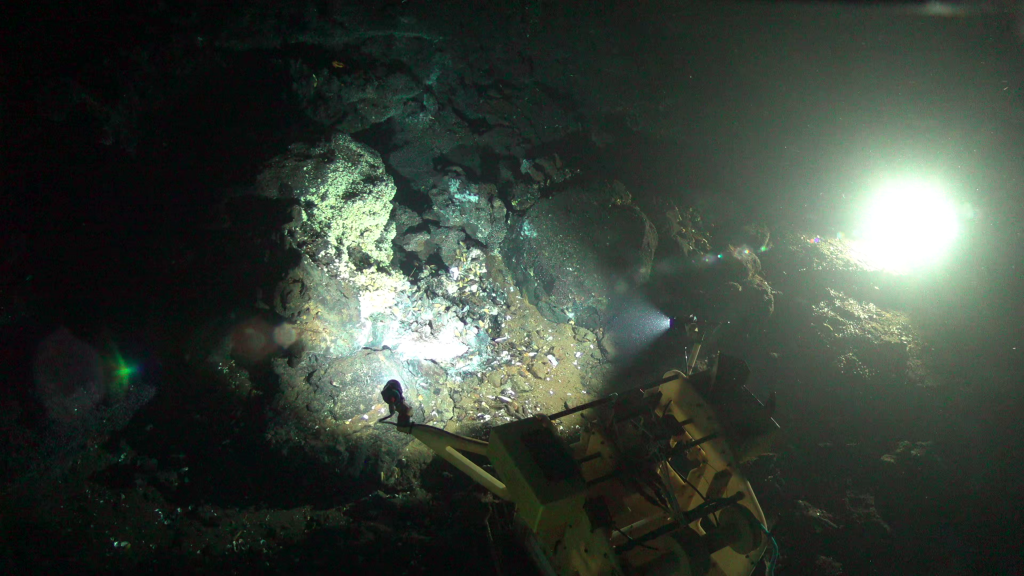
Figure 2. The submersible Nautile filming the TEMPO ecological module deployed at 1700 m depth at the base of the Eiffel Tower active hydrothermal edifice.
Authors: Marjolaine Matabos and the EMSO-Azore consortium (Ifremer, BEEP research Unit, France)
To go further: Matabos, M., Cannat, M., Ballu, V., Barreyre, T., Blandin,J., Castillo, A., Cathalot, C., Chavagnac, V., Chu, N. C., Colaço, A.,Crawford, W., Escartin, J., Ferron, B., Fontaine, F., Gautier, L., Godfroy, A.,Laes-Huon, A., Lanteri, N., Leau, H., … Sarradin, P. M. (2025). The EMSO-Azores deep-sea observatory: 15 years of multidisciplinary studies of the lucky strike hydrothermal system, from sub-seafloor to the water column. Journal of Sea Research, 207, 102625.https://doi.org/https://doi.org/10.1016/j.seares.2025.102625