

Marine scientists and industrial engineers have launched a breakthrough field trial at the EMSO-OBSEA cabled underwater observatory to combat one of oceanography’s most persistent operational challenges: biofouling.
The project, titled UVP6-BF (A new dedicated UV-C system for the protection of the UVP6 porthole against biofouling), is validating an innovative, ultra-low-power Ultraviolet-C (UV-C) protection system designed to safeguard advanced optical devices like the Underwater Vision Profiler 6 (UVP6). This international collaboration brings together industrial partner Hydroptic, the Laboratoire d’Océanographie de Villefranche sur mer (LOV), and the EMSO-OBSEA regional facility to validate a smart, low-power system designed to keep optical surfaces perfectly clear.
While these instruments have revolutionized ocean observation by capturing high-resolution, in situ data to track the ocean’s blue carbon pump, their vulnerability to rapid biological growth in sunlit coastal waters has long tied them to costly, frequent manual diver maintenance. Within days, a buildup of algae and barnacles blinds the lenses and corrupts critical data streams.
The newly deployed system introduces a major engineering shift. By developing an affordable, universally backward-compatible module that seamlessly clips directly onto the existing global fleet of approximately 200 UVP6 sensors, this international collaboration offers a highly scalable solution. Tailored specifically for energy-restricted autonomous platforms like gliders and profiling floats, the UVP6-BF project aims to keep subsea lenses pristine for long-term deployments without sacrificing battery longevity or operational lifespan.
From Foundation to Innovation: The Evolution of UVP6-BF
This initiative strengthens a fruitful international collaboration originally catalyzed by ANERIS (operAtional seNsing lifE technologies for maRIne ecosystemS), a flagship Horizon Europe project dedicated to pioneering next-generation tools for operational marine biology.
Under the ANERIS framework, researchers from LOV and the host facility Universitat Politècnica de Catalunya (UPC) successfully deployed standard UVP6 sensors at the OBSEA observatory to automate the monitoring of marine life. However, those initial deployments exposed a critical operational bottleneck: rapid biofouling in sunlit, shallow waters required frequent and costly manual cleaning by divers.
The newly launched UVP6-BF project, funded within the framework of the EMSO ERIC Physical Access Programme, acts as the direct answer to this challenge, introducing a breakthrough anti-biofouling solution. Speaking on the scientific significance of the fleet’s expansion, a representative from the Laboratoire d’Océanographie de Villefranche-sur-mer (LOV) emphasizes:
“With approximately 200 units deployed globally across gliders, profiling floats, and cabled observatories, the UVP6 has become a standard instrument for in situ quantification of particle size spectra and zooplankton assemblages. The rapid expansion of this fleet into shallow-water, battery-constrained coastal platforms has driven the need for an optimized, low-power solution that drastically reduces data gaps and maintenance costs”, says Camille Catalano, Principal Investigator of the project, from Sorbonne University.
While high-power commercial UV-C systems are already available on the market, the true innovation of this new system, manufactured by Hydroptic under a Sorbonne University and CNRS license, lies in its strategic, market-ready engineering approach:
- Universal Retrofitting: Instead of forcing research institutions to purchase expensive new sensor models, this system is uniquely engineered as a backward-compatible module that seamlessly clips directly onto the existing global fleet of approximately 200 UVP6 sensors.
- Ultra-Low Power Optimization: It features an ultra-efficient electronic architecture tailored specifically for energy-restricted coastal platforms, such as autonomous gliders and profiling floats, where power consumption dictates deployment longevity.
- Dynamic Duty-Cycle Engineering: Utilizing OBSEA’s cabled subsea power supply, engineers can systematically test varying duty cycles. By correlating computer vision analysis of biological growth against real-time environmental data, the team aims to mathematically pinpoint the absolute minimum UV-C exposure required to halt biofouling, maximizing lens clarity while minimizing energy draw.
Rigorous Validation via Subsea Infrastructure
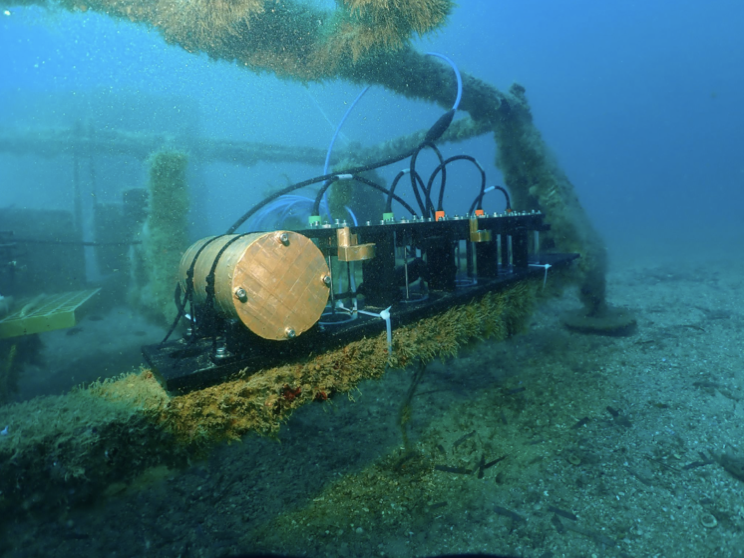
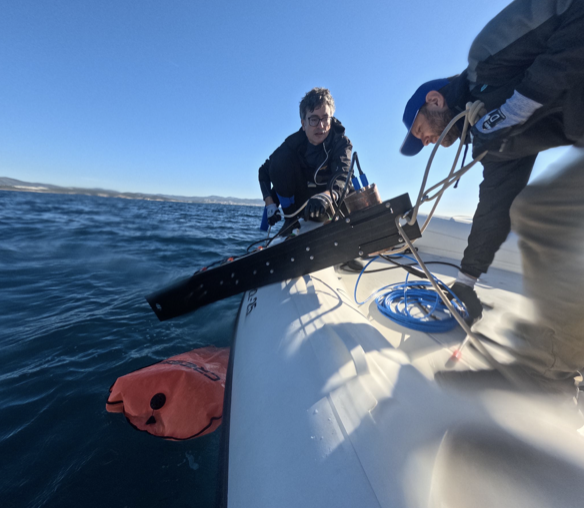
To transition this technology from the laboratory to the commercial market, prototypes have been deployed for a one-year validation trial at the cabled subsea infrastructure of the EMSO-OBSEA observatory in Vilanova, Spain.
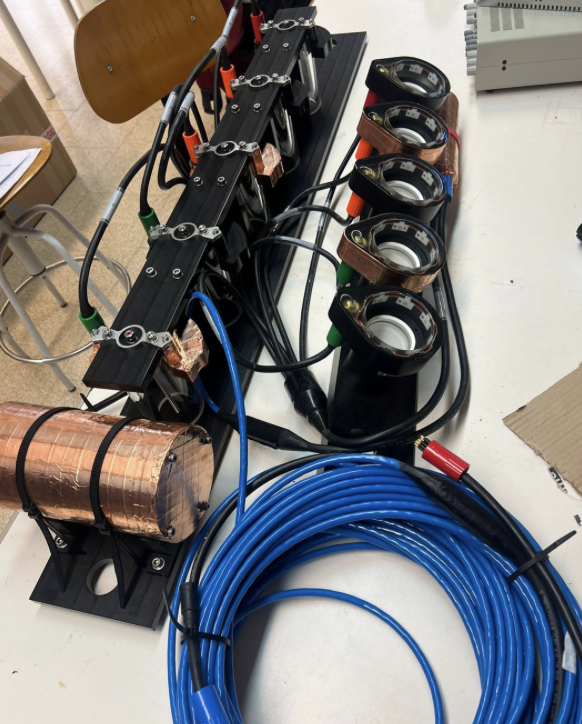
Connected directly to OBSEA’s subsea junction box, the prototypes run continuously without battery constraints, allowing the technical team to monitor power consumption in real time. The testing framework utilizes two distinct configuration layouts to track surface fouling dynamics across varied profiles:
- Camera System Emulation: A layout precisely matching the standard UVP6 window geometry and sensor view.
- Cylindrical Housing Reproductions: A setup designed to emulate traditional cylindrical instrument architecture.
Highlighting the hands-on operation and data integration at the marine laboratory, the EMSO-OBSEA regional facility technical team explains:
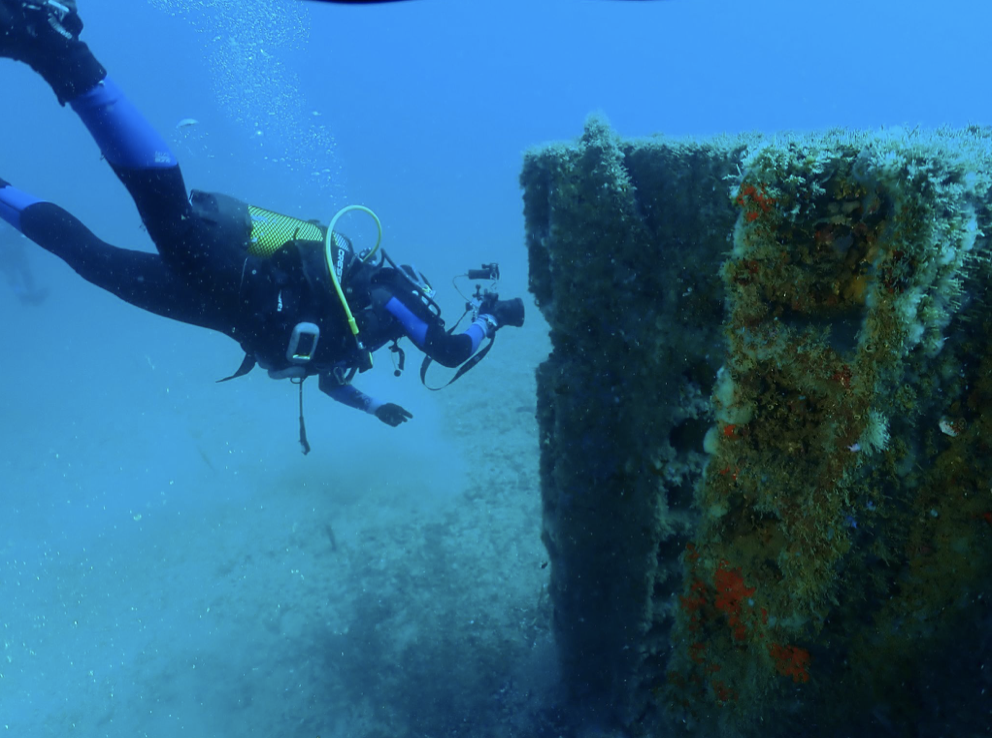
“We carry out regular visits to the OBSEA site as part of our routine operations, performing at least one visit per week at this time of the year. During these operations, we visually inspect the systems, verify their status, and acquire images of the portholes to monitor the progression of biofouling. A key component of this project is leveraging real-time environmental data from the OBSEA observatory, such as sea temperature, dissolved oxygen, turbidity, and ocean currents, to directly correlate environmental changes with biological growth on the optical surfaces”, says Matias Carandell Widmer, Assistant Professor at Universitat Politècnica de Catalunya and member of the EMSO OBSEA-SARTI group.
Turning Visual Audits into Engineering Insights
The continuous presence of the technical team ensures that visual data collection feeds directly back into the design loop.
“By using computer vision to process the weekly dive imagery, we can precisely map biological growth against OBSEA’s real-time environmental data. Tracking how factors like temperature spikes or turbidity accelerate fouling under active UV-C suppression allows us to mathematically optimize the system’s efficiency”, explains Jerome Coindat, General manager at Hydroptic.
When a technical anomaly recently arose with one of the configurations, the accessibility of the cabled site allowed for a rapid recovery. The affected unit was safely returned to the Hydroptic factory for failure analysis and routine repairs, while the second unit remained fully operational, ensuring continuous, uninterrupted data collection.
From Testbed to Global Market: Scaling Commercial Impact
The empirical field data gathered at OBSEA will immediately feed into the next phase of development. Moving forward, the assembly will interface with an advanced junction box custom-engineered by the EMSO OBSEA team to continuously refine and isolate the optimized duty cycles.
While the project partners do not plan to patent the system, recognizing that UV-C protection itself is a well-established concept, the true value lies in bringing a highly specialized, affordable, and field-proven shallow-water variant of the UVP6 directly to the global market.
This project builds on a highly successful, 16-year commercial partnership. In 2010, LOV licensed the predecessor UVP5 instrument to Hydroptic, resulting in the commercialization of approximately 30 units and the acquisition of over 10,000 ocean profiles worldwide. By 2014, this collaboration evolved to develop the current UVP6, which now boasts a global footprint of roughly 200 units. These sensors are deployed across diverse, high-fouling environments, including shallow monitoring stations in Norway and major cabled networks such as EMSO-Ligure Ouest, EMSO-OBSEA, and EMSO-SMARTBAY.
Author: Sara Pero, EMSO ERIC