

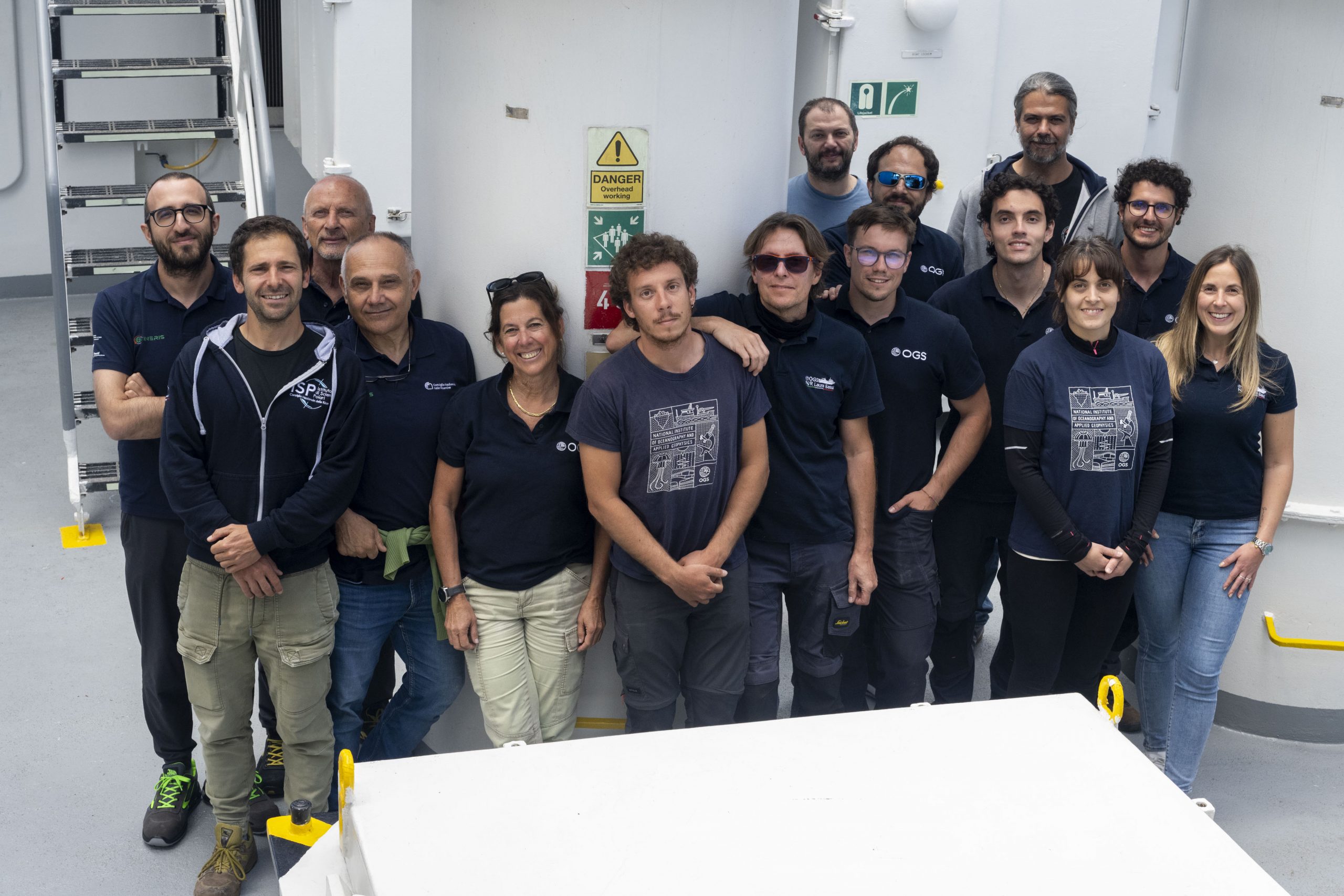
The EMSO-SA (European Multidisciplinary Seafloor and Water Column Observatory – Southern Adriatic) oceanographic campaign led by the National Research Council (CNR) has successfully come to a close, following an intensive mission aboard the research vessel Gaia Blu.
Setting sail from the port of Bari, the expedition explored the depths of the southern Adriatic Sea, focusing on the maintenance and operation of underwater observatory sites within the EMSO ERIC European network—an advanced system dedicated to the continuous monitoring of ocean health.
At sea, Gaia Blu becomes much more than a vessel: it is a fully equipped floating laboratory. “Across the seafloor and throughout the entire water column, sensors, sediment traps, and buoys are constantly at work, collecting real-time data on temperature, currents, oxygen levels, and biodiversity,” explains Stefano Miserocchi of the CNR Institute of Polar Sciences (CNR-ISP) in Bologna and coordinator of the EMSO-SA campaign. “These instruments provide a dynamic, ever-evolving picture of the marine environment. During the mission, observatory systems were recovered, data retrieved, batteries replaced, and equipment carefully serviced before being redeployed—ready to operate autonomously for at least one year, even under extreme conditions.”
A key role in this effort is played by oceanographic moorings. “These deep-sea platforms, anchored at depths exceeding one thousand meters, continuously record physical and biogeochemical data from the ocean’s interior,” notes Vanessa Cardin of the National Institute of Oceanography and Applied Geophysics (OGS) and coordinator of the southern Adriatic EMSO Regional Facility. “They act as true sentinels of the sea, allowing us to track long-term changes in marine systems and better understand the impacts of climate change on ecosystems and ocean circulation.”
The campaign also included CTD casts—advanced probes that measure conductivity, temperature, and depth, essential for determining salinity. These measurements were complemented by water sampling, used both to calibrate moored instruments and to carry out detailed biogeochemical analyses of the ocean’s carbonate system and acidification processes.
“These activities are crucial to ensuring the accuracy and long-term stability of the data,” adds Cardin. “They allow us to build increasingly reliable time series, which are fundamental for detecting subtle environmental changes over time.”
An important upgrade has been implemented on the E2M3A meteo-oceanographic buoy with the installation of an inductive cable, which will enable the real-time transmission of data collected by various sensors located at depths of up to 700 meters.
One of the most scientifically significant areas investigated is the Bari Canyon, located about 22 nautical miles offshore. This deep underwater valley plays a pivotal role in the circulation of the southern Adriatic. “Here, powerful bottom currents transport dense water masses from the northern Adriatic into the deep sea, carrying oxygen, carbon dioxide, sediments, and even pollutants,” explains Miserocchi. “This natural ‘conveyor belt’ helps ventilate deep waters and makes the canyon a unique natural laboratory for studying climate dynamics and their effects on marine ecosystems.”
Missions like this are essential for decoding the rapid changes taking place in the Mediterranean Sea. By monitoring ecosystem health and identifying potential natural risks, they provide critical data for understanding—and protecting—the marine environment.
At the heart of these efforts is Gaia Blu (82.9 m long, 13.0 m beam), the flagship research vessel of the CNR. Designed to support geological, oceanographic, biological, and atmospheric studies, it enables scientists to explore the Mediterranean and global oceans, from coastal regions to the most remote and challenging environments on Earth.
Authors:
Stefano Miserocchi and Francesco Paladini de Mendoza (CNR-ISP, National Research Council of Italy -Institute of Polar Sciences); Vanessa Cardin (Istituto Nazionale di Oceanografia e di Geofisica Sperimentale – OGS)
Photo: Scientific crew of EMSO SA 2026 Cruise (Credit V. Tulli, CNR)