

Understanding the impact of underwater noise on marine ecosystems requires sustained, high-quality observations combined with robust data management and analytical approaches. In this context, the Oceanoise2026 conference provided an opportunity to present recent results from the AQUARIUS project, building on data and activities carried out at the EMSO Western Mediterranean Sea Regional Facility.
The contribution specifically addressed a key methodological challenge in marine acoustic monitoring: how sampling design influences the interpretation of underwater soundscapes. Using a dual hydrophone setup deployed at the observatory, the study examined how different acquisition strategies affect the detection, representation, and quantification of acoustic signals in a complex marine environment.
Fixed-point observatories such as the EMSO Western Mediterranean Sea Regional Facility provide continuous passive acoustic monitoring, generating long-term time series that are fundamental for identifying trends in both natural and anthropogenic noise. However, these observations are inherently shaped by sampling choices, including temporal resolution, duty cycling, and sensor characteristics. These factors can introduce biases or limitations in the ability to resolve transient events, low-frequency variability, and biologically relevant signals.
To investigate these aspects, two complementary acoustic datasets were analysed. The first consisted of broadband, high-sensitivity measurements acquired with a RESON TC4032 hydrophone, sampled for 30 seconds every 10 minutes, enabling high-frequency resolution and detailed characterization of short-duration acoustic events. The second dataset comprised long-duration recordings collected with an AURAL M3 autonomous recorder, acquiring 10-minute segments every hour, better suited for capturing longer-term variability and persistent sound sources.
A suite of spectral, temporal, and statistical metrics was applied to both datasets to assess their capability to represent key acoustic processes. These included commercial shipping noise, small vessel activity, wind-driven sound, precipitation events, and marine mammal vocalizations. The comparison highlighted how different acquisition schemes can selectively enhance or constrain the detection of specific sound sources, ultimately influencing the ecological interpretation of the soundscape.
A central outcome of the study is the demonstration that sampling strategy is not a neutral choice but a critical component of the observing system that directly affects the robustness, comparability, and ecological relevance of acoustic indicators. This is particularly important in the context of long-term monitoring programmes and regulatory frameworks, where consistent and reliable metrics are required.
The work also emphasized the value of integrating passive acoustic data with environmental parameters (e.g., meteorological and oceanographic conditions) to better explain soundscape variability and to disentangle overlapping noise sources. Such multi-parameter approaches are essential for advancing our understanding of the drivers of underwater noise and their potential impacts on marine ecosystems.
Overall, this activity highlights the strategic role of EMSO observatories as platforms for both technological innovation and methodological development. By enabling controlled comparisons of acquisition strategies and supporting multidisciplinary data integration, EMSO infrastructures contribute significantly to improving the quality, interoperability, and scientific value of ocean noise observations at the European scale.
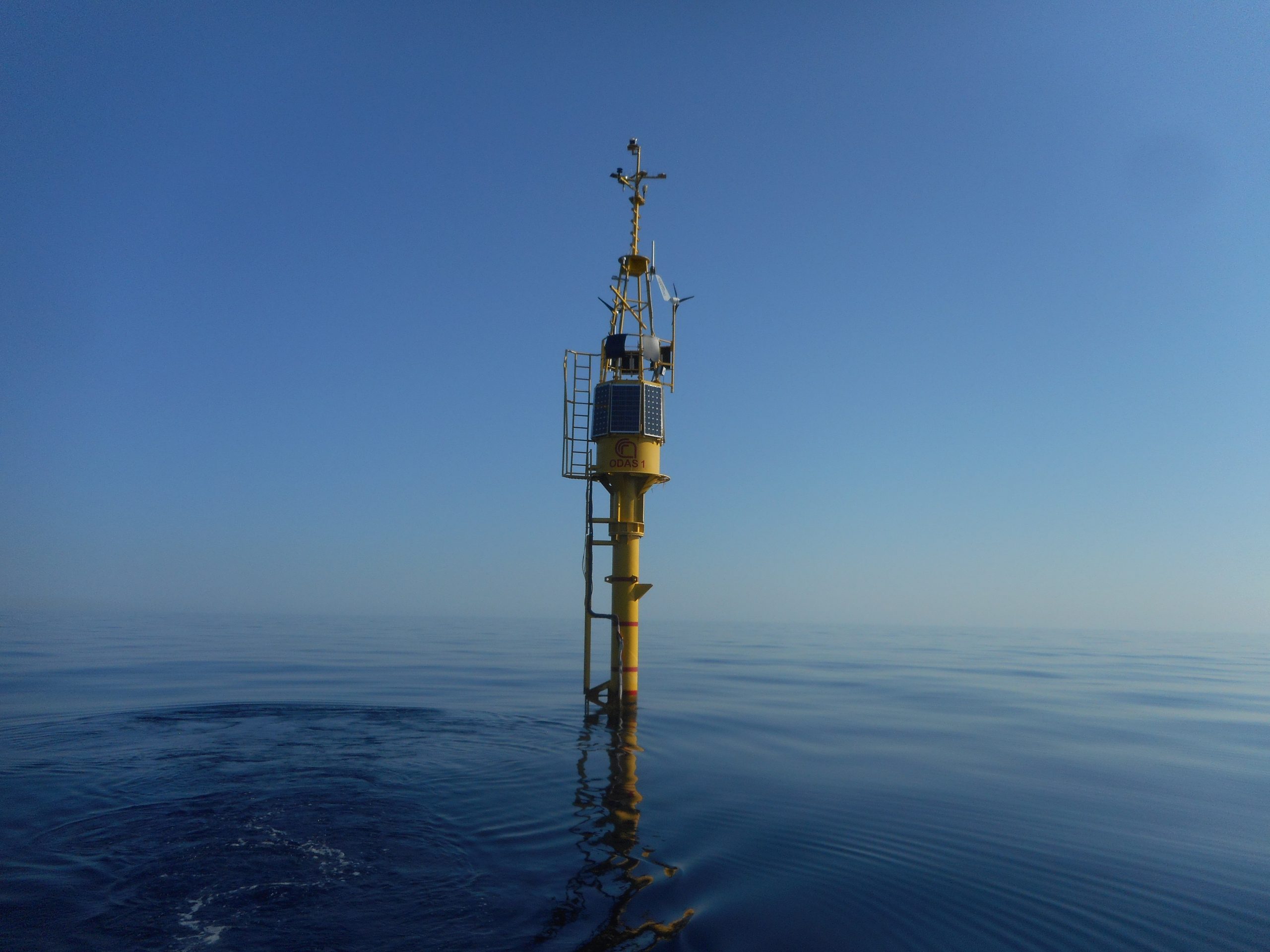
Figure 1. The Western Mediterranean Sea regional facility standing out of the water. Credits: Roberto Bozzano, CNR, Genoa (Italy).
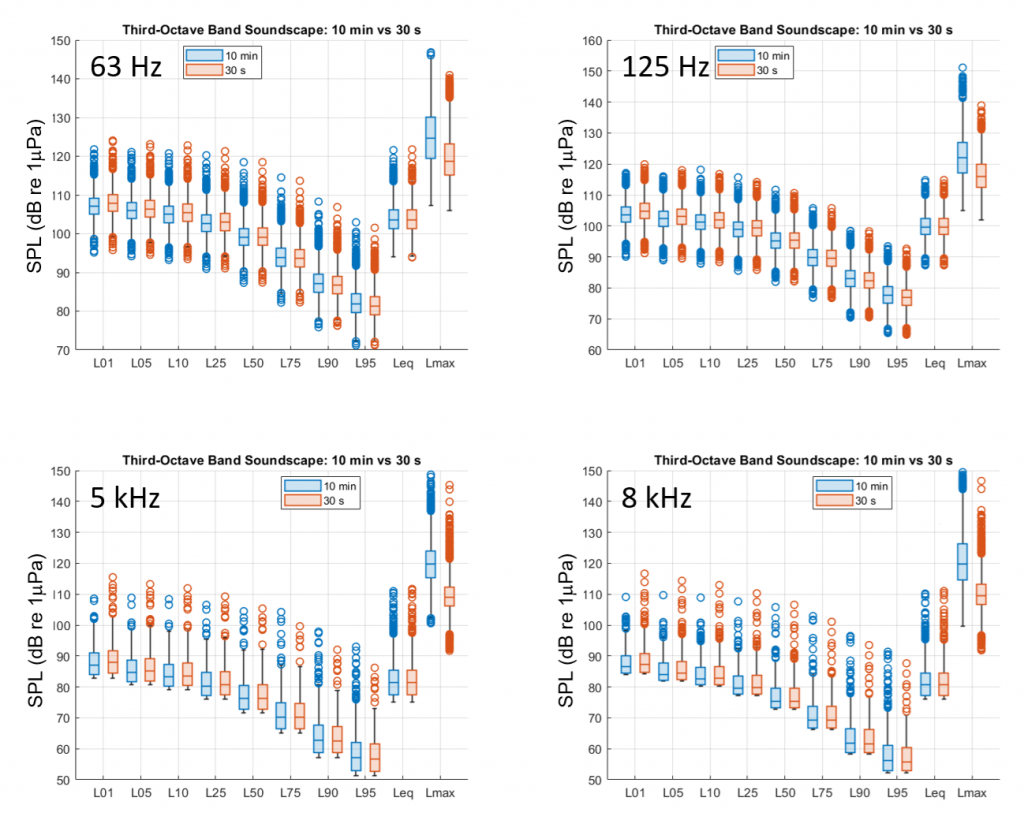
Figure 2. Box plots of percentiles of third-octave bands for selected frequencies (63 Hz, 125 Hz, 5 kHz, 8 kHz) show comparable estimates of the background and typical sound field, indicating that even the shorter sampling mode is generally sufficient for describing the overall soundscape. The shorter duty cycle appears suitable for characterizing general and persistent acoustic conditions, whereas the longer continuous recordings are more appropriate when the objective is to resolve extreme events and the upper tail of the sound-level distribution. Credits: Sara Pensieri, CNR, Genoa (Italy).
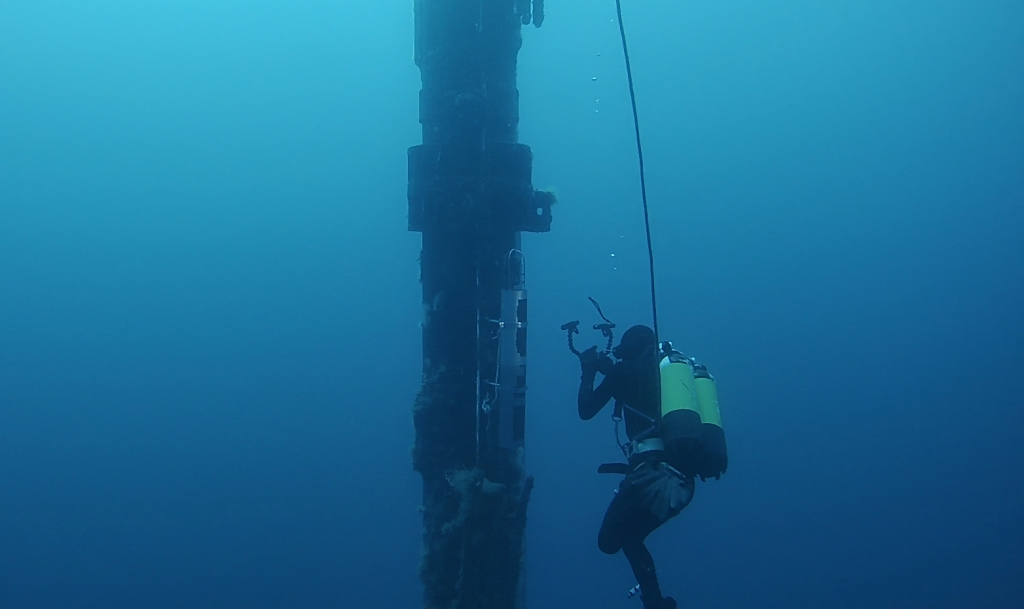
Figure 3. Diver filming an autonomous acoustic recorder deployed on the W1M3A spar buoy at about 30 m depth. Credits: Roberto Bozzano, CNR, Genoa (Italy)
Authors: Sara Pensieri, Roberto Bozzano, Consiglio Nazionale delle Ricerche, CNR (Italy)