
Cabled underwater observatories provide continuous power, high-capacity communications and near-real-time access to multidisciplinary ocean data. During the EuroGOOS Fixed Platforms Task Team meeting in Valletta, EMSO ERIC presented how these infrastructures support applications ranging from automated marine biodiversity monitoring to earthquake detection, climate observation and tsunami early warning.
Picture credit: The University of Malta
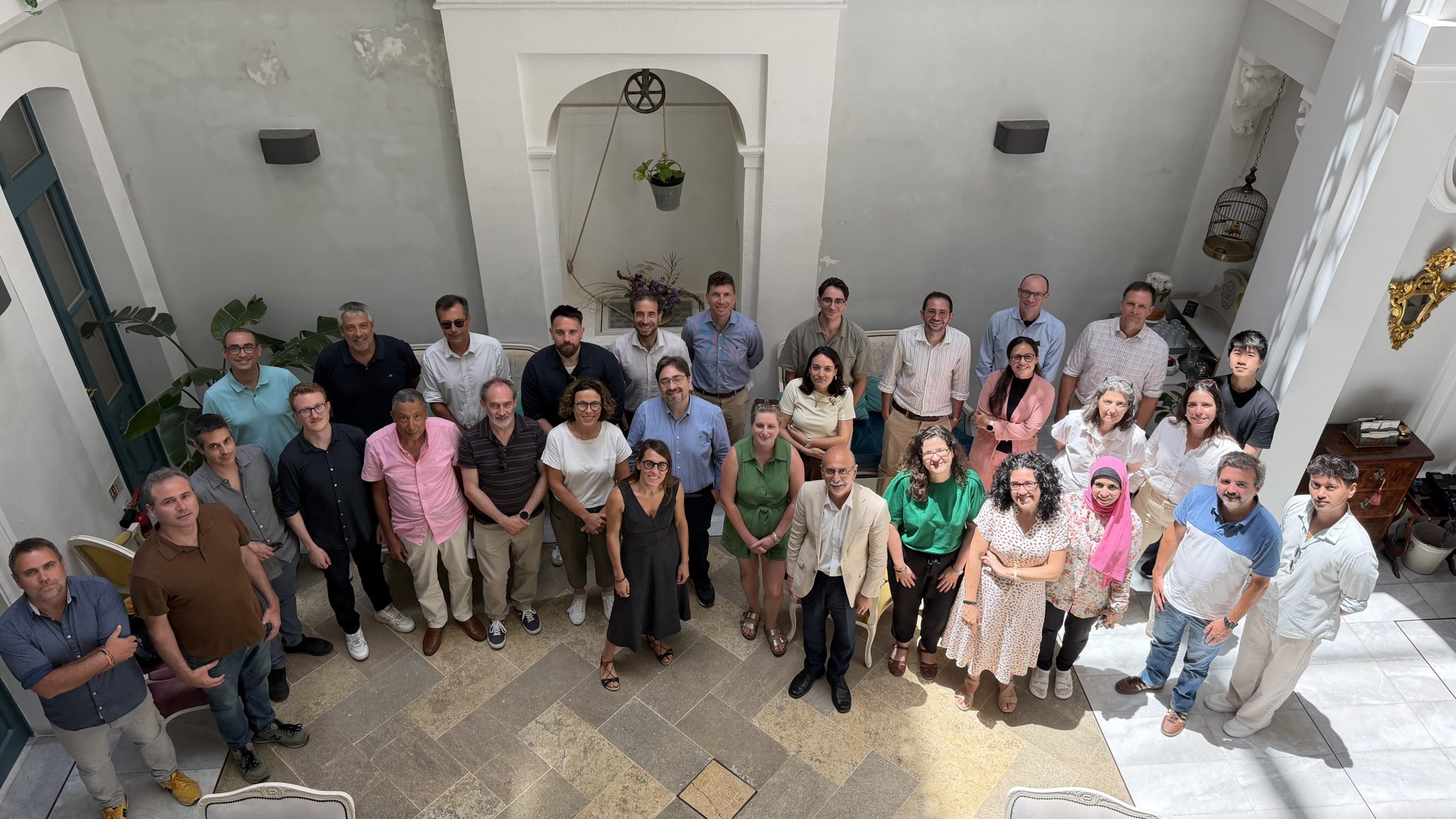
Participants in the joint EuroGOOS High Frequency Radar and Fixed Platforms Task Team workshop, held in Valletta, Malta, on 14-15 July 2026.
Strengthening European cooperation in fixed ocean observation
Researchers, engineers and marine infrastructure operators met in Valletta, Malta, on 14-15 July 2026 for the joint EuroGOOS High Frequency Radar and Fixed Platforms Task Team workshop.
The meeting provided an opportunity to exchange technical experience, discuss shared operational challenges and identify priorities for the future development of European ocean-observation systems. The programme covered topics including data standards, quality control, biofouling, sensor calibration, data latency, stakeholder requirements and cooperation between different observing platforms.
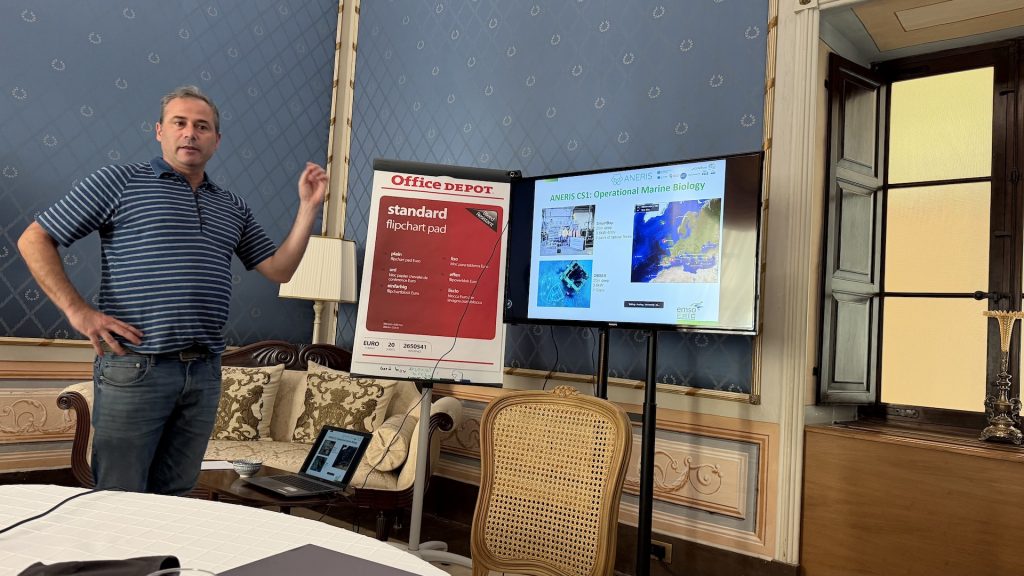
As part of the Fixed Platforms Task Team programme, Simo Cusi, Engineering and Logistics Officer at EMSO ERIC, presented the contribution of cabled observatories to real-time ocean monitoring and scientific services.
The EuroGOOS Fixed Platforms Task Team brings together organisations operating long-term observing systems such as cabled observatories, moorings, buoys and other fixed marine platforms. Its work helps operators share practical experience, improve coordination and develop common approaches to data quality, technology and service provision.
For EMSO ERIC, this cooperation provides an important framework for sharing experience from its distributed network of observatories and contributing to a more coordinated European ocean-observing capacity.
 Picture credit: The University of Malta
Simo Cusi, EMSO ERIC Engineering and Logistics Officer, presenting the role of cabled observatories in real-time ocean monitoring during the EuroGOOS Fixed Platforms Task Team meeting.
Why cabled observatories matter
Many ocean processes occur suddenly, develop over long periods or take place in areas that are difficult to access regularly. Research vessels and short-term scientific campaigns remain essential, but they provide observations for a limited period and cannot always capture unexpected events.
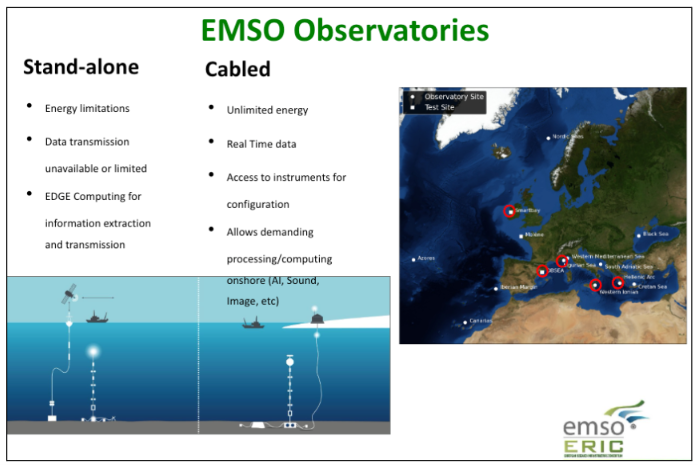
Fixed observatories complement these activities by collecting measurements continuously from the same location. Stand-alone systems rely on batteries and usually have limited communication capacity. Their data may only become available when the instrument is recovered or through restricted satellite and acoustic connections.
Cabled observatories are connected to land through submarine power and communication cables. This allows instruments to operate continuously, transmit large volumes of data in near real time and be configured remotely. Their high-bandwidth connections also support applications that require intensive processing, including underwater imaging, acoustic monitoring and artificial intelligence.
A single cabled observatory can host instruments covering several scientific disciplines. Researchers can therefore study physical, biological, chemical and geological processes at the same time, from the water column to the seafloor.
Taken from Simo Cusi presentation from EuroGOOS Fixed Platform Task Team Meeting
Comparison between stand-alone and cabled observatories. Cabled systems provide continuous power, real-time data transmission and remote access to instruments, supporting demanding applications such as image, sound and artificial-intelligence processing.
Operational Marine Biology at OBSEA and SmartBay
One of the examples presented in Malta was ANERIS Case Study 1, which is developing an approach known as Operational Marine Biology. The objective is to make biological monitoring more continuous, automated and operational. Physical variables such as temperature, salinity and currents are already measured routinely at many ocean-observation sites. Operational Marine Biology aims to establish similar long-term services for observing marine organisms and ecosystems.
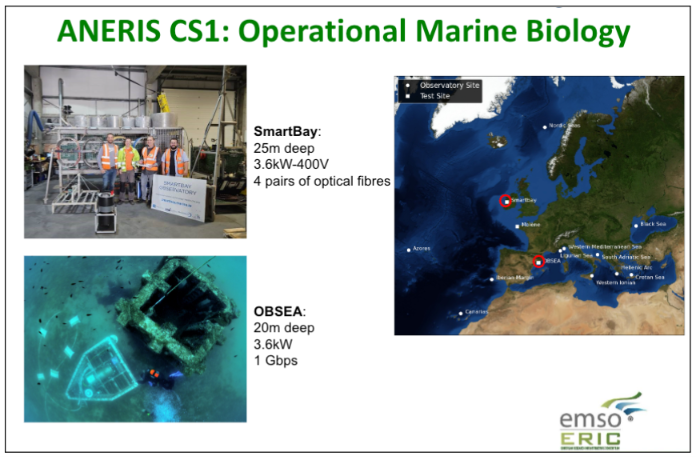
The work is being carried out at two EMSO cabled observatories:
- EMSO-OBSEA: a shallow-water observatory in the Mediterranean Sea operated by the Universitat Politècnica de Catalunya;
- EMSO-SmartBay: an Atlantic test site operated by the Marine Institute in Ireland.
Both facilities provide continuous power and high-capacity fibre-optic communications, allowing several instruments to operate simultaneously and transmit their observations to land.
 Taken from Simo Cusi presentation from EuroGOOS Fixed Platform Task Team Meeting
EMSO-OBSEA in the Mediterranean and EMSO-SmartBay in the Atlantic provide cabled environments for continuous marine observation and the testing of new technologies.
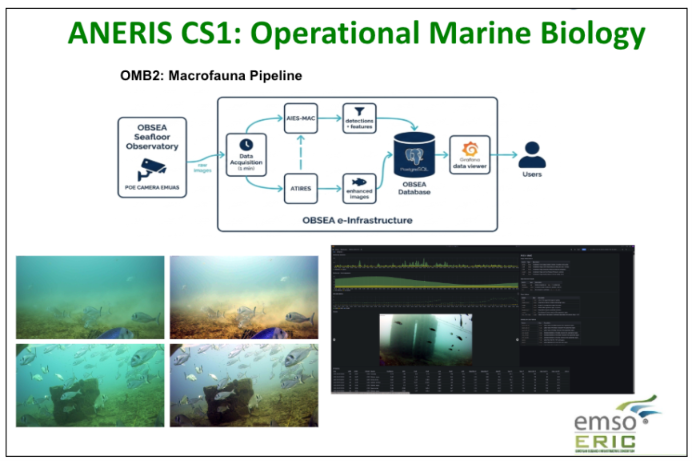
The ANERIS case study combines different instruments to observe marine life across several size ranges a CytoSub underwater flow cytometer for phytoplankton; an Underwater Vision Profiler 6, or UVP6, for particles and zooplankton; and expandable Multicamera Underwater Acquisition System cameras, known as EMUAS, for fish and other larger organisms.
These instruments produce large quantities of images and measurements. Machine-learning methods are used to process the information, recognise organisms and organise the results into datasets that can be used by researchers. The work covers two complementary observation pipelines. The first focuses on phytoplankton and zooplankton, while the second uses camera systems to observe fish and other macrofauna.
The longer-term objective is to operate the full process in near real time from data collection and quality control to automated analysis and access through scientific data services. This could support the identification of events such as plankton blooms, changes in species abundance or unusual biological activity. The resulting observations contribute to the monitoring of the Biology and Ecosystems Essential Ocean Variables identified by the Global Ocean Observing System. In the future, these datasets could be made more widely available through the EMSO Data Portal.
Taken from Simo Cusi presentation from EuroGOOS Fixed Platform Task Team Meeting
The ANERIS macrofauna pipeline uses underwater cameras and automated image processing to support continuous observation of fish and other larger marine organisms.
Using optical fibres as environmental sensors
The presentation also examined the growing potential of Distributed Optical Fibre Sensing. This approach uses light travelling through an optical fibre to detect very small changes along the cable. A specialised instrument, known as an interrogator, sends laser pulses through the fibre and analyses the reflected light. Depending on the method used, the cable can detect acoustic signals, temperature changes or strain. Measurements can be collected at short intervals along many kilometres of fibre, effectively turning an existing submarine cable into a dense network of environmental sensors.
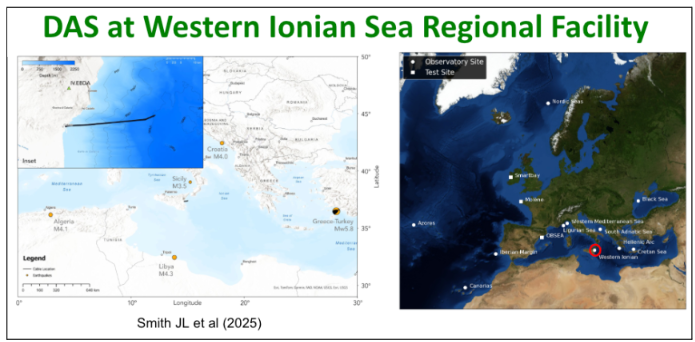
At the EMSO Western Ionian Sea Regional Facility, an EMSO-supported Physical Access project led by researchers from the National Oceanography Centre used approximately 28 kilometres of submarine fibre-optic cable extending to a depth of around 2,000 metres. The experiment demonstrated the range of processes that can be observed through a single cable. Potential applications include detecting underwater landslides and sediment movement, monitoring marine mammals, studying internal waves and turbulence, and recording seismic activity.
An initial analysis of the observations also enabled researchers to locate five earthquakes in the Mediterranean (Smith, J.L., Belal, et al. 2026). This type of sensing produces very large volumes of information up to tens of terabytes per day in the Western Ionian Sea experiment. Developing efficient methods for processing, selecting and transmitting the most useful data will therefore be essential for future operational services.
Taken from Simo Cusi presentation from EuroGOOS Fixed Platform Task Team Meeting
The EMSO Western Ionian Sea Regional Facility provided access to a 28-kilometre submarine fibre-optic cable for testing Distributed Acoustic Sensing in the Mediterranean.
SMART cables for climate and geohazard monitoring
The final part of the presentation focused on Science Monitoring and Reliable Telecommunications cables, commonly known as SMART cables. SMART systems combine submarine communications infrastructure with scientific sensors. Sensor packages installed at intervals along the cable can measure variables such as: temperature, water pressure, seafloor acceleration, and seismic activity.
Because submarine telecommunications cables cross large and often remote ocean areas, integrating scientific sensors into these systems could greatly expand the geographical coverage of marine observations. The measurements could contribute to long-term deep-ocean temperature records, climate research, earthquake detection and tsunami early-warning systems. Continuous power and communications would also allow data to reach researchers and monitoring authorities in near real time.
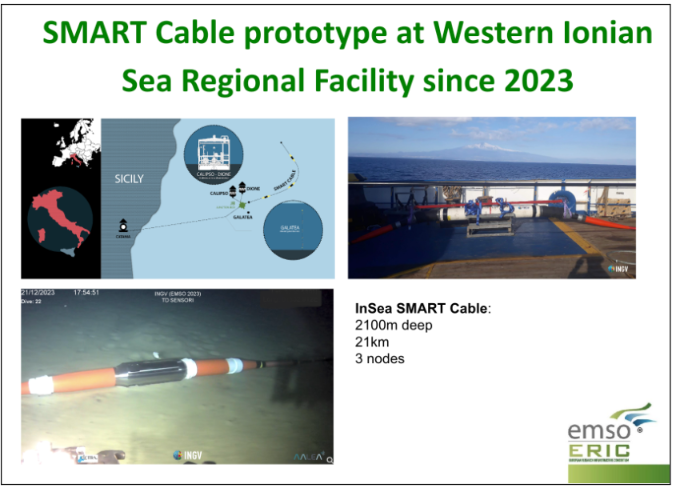
Since 2023, a SMART cable prototype has operated at the EMSO Western Ionian Sea Regional Facility. The system extends for approximately 21 kilometres, reaches a depth of around 2,100 metres and includes three sensor nodes. Its measurements demonstrate how a cabled system can collect several types of environmental and geophysical data from the deep ocean over long periods. EMSO is also contributing technical experience to future initiatives involving SMART cables and optical-fibre sensing, including projects currently under development such as IOEMA and MISTS.
Taken from Simo Cusi presentation from EuroGOOS Fixed Platform Task Team Meeting
The SMART cable prototype at the EMSO Western Ionian Sea Regional Facility includes three sensor nodes along a 21-kilometre cable reaching approximately 2,100 metres below the surface.
Building a stronger fixed-platform community
Although Operational Marine Biology, fibre-optic sensing and SMART cables address different scientific questions, they rely on many of the same operational foundations. They require reliable platforms, sustained maintenance, calibrated instruments, effective quality-control procedures and systems capable of managing increasingly large datasets.
These shared needs are central to the work of the EuroGOOS Fixed Platforms Task Team. By bringing together observatory operators from across Europe, the Task Team supports the exchange of practical experience on issues such as sensor performance, biofouling, calibration schedules, instrument failures, data flagging and communication requirements.
The cooperation is becoming increasingly important as fixed platforms support more automated services and begin to integrate artificial intelligence, advanced imaging and real-time data processing. Closer coordination can also improve interoperability between observatories and help connect fixed platforms with wider European and international ocean-observation initiatives.
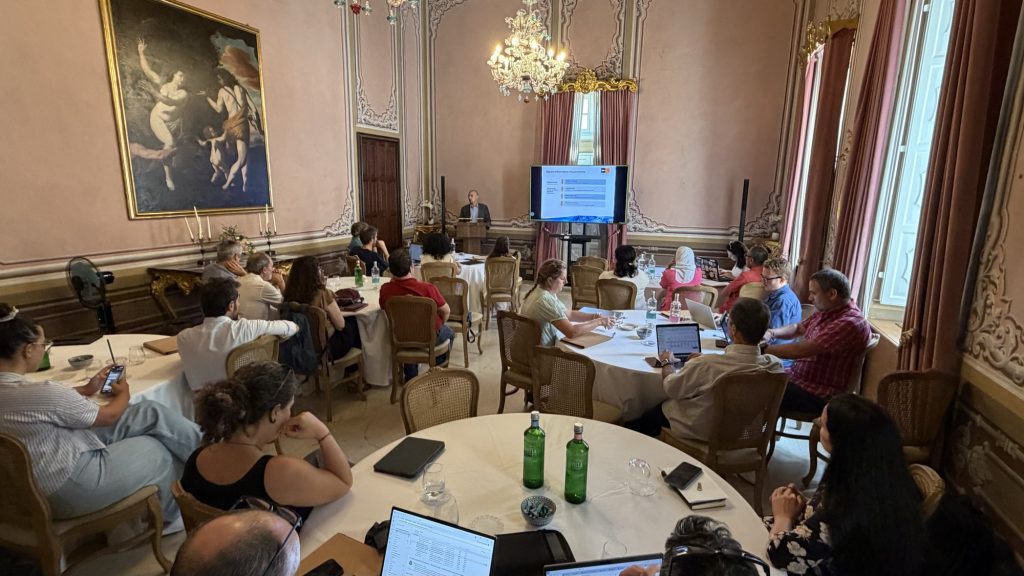 Picture credit: The University of Malta
Members of the EuroGOOS Fixed Platforms Task Team discussing shared operational challenges and future priorities for European fixed ocean-observation systems.
Looking ahead
The examples presented in Malta show that cabled observatories are no longer limited to monitoring a small number of physical variables. The same infrastructure can support biological cameras, plankton sensors, acoustic instruments, seismometers, pressure sensors and fibre-optic technologies. Together, these systems provide a more complete view of changes occurring in the ocean and beneath the seafloor.
The next steps will include improving automated biological-analysis pipelines, strengthening quality-control procedures, managing the large datasets generated by fibre sensing and continuing the testing of SMART cable technologies. Equally important will be cooperation among research infrastructures, scientific institutions, public authorities, technology providers and ocean-observation networks. Through its participation in the EuroGOOS Fixed Platforms Task Team, EMSO ERIC will continue sharing operational experience from its Regional Facilities and contributing to more coordinated, reliable and user-oriented ocean-observation services in Europe.
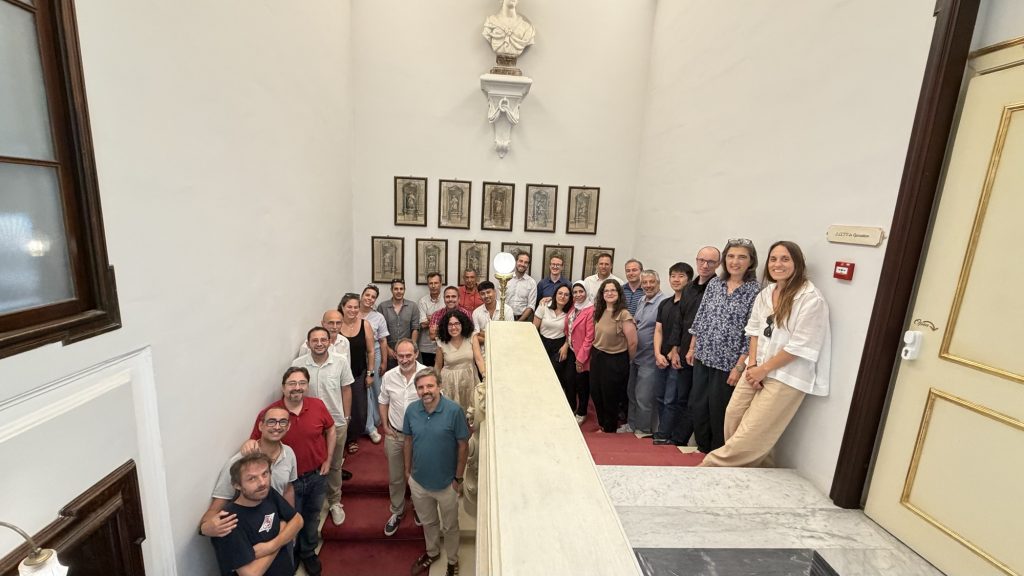 Picture credit: The University of Malta
Participants at the conclusion of the joint EuroGOOS High Frequency Radar and Fixed Platforms Task Team workshop in Valletta.